How Hawkman Soars: A Five-Panel Explainer

By Zack Quaintance — Hawkman by Robert Venditti and Bryan Hitch feels like a throwback (in a good way) for a couple reasons. First, it’s a story of a modest scale. This is an odd notion, given we're talking about a comic that spans all of space and time, but at its core Hawkman is a relatively simple adventure starring a character who is unraveling personal mysteries while also combating threats to the larger world. Second, it features killer artwork by Bryan Hitch.

Regarding Hitch: it’s often hard to see how the standards and conventions of a storytelling medium limit it until someone breaks them. This was true of my perception of comics in the ‘90s (a super weird decade, yet not as bad as its reputation...a topic for another day). Hitch’s work on The Authority showed me the freeing potential of excessively splashy spreads brimming with gigantic action and wide perspective. Basically, I’d never realized how claustrophobic most books felt until Hitch blew it up.

Lately I’d forgotten how much a revelation his style once was, especially since it has now become commonplace in superhero stories. Obviously, it’s not a fit for every book, and it has maybe been overdone at times (way overdone), but when used well as it is in Hawkman—look out. And so that’s what I’d like to discuss today via five-panel explainer: how Hawkman soars on the wings of old school adventuring and free-flying artwork. Let’s do it!  

Panel One - The Continuity

Like many DC heroes, Hawkman is a great character with a long and convoluted history, one that can potentially act as a barrier of entry for new readers. Venditti and Hitch realize this, and in Hawkman #1 we get this stunning panel, which orients us and conveys the basics while also establishing that this book is about our hero himself coming to terms with his background. Basically, they’re telling us relax...it’s okay to be confused. We’re heading out—together—to explore.

This killer spread from Hawkman #1 does a great job refreshing the current state of Hawkman's continuity. 

Panel Two - The Journal

From Hawkman #3, our hero pours through his journal, reminding us of the status of his quest.

This second panel is less visually-exciting, yet it’s just as important as the one above in terms of giving structure to the narrative. If that frenetic spread establishes we’re sorting out our hero’s past together, the journal acts as a device for reminding us what we’ve so far learned. It gives our protagonist an organic means of taking stock of his progress, and it gives Venditti a nice way to craft interesting narration without showing the writer’s hand in the story. It’s been well-done through three issues, and I'm hoping we’ll see more of it moving forward.

Panel Three - The Museum

Not to go too far into the story, but this book is about Hawkman learning he’s been reincarnated not just over time but also throughout space. In any given issue, the story goes to another planet, another time, and then back to present day. It’s a lot and it could become unwieldy...if Venditti and Hitch weren’t so good at creating pedestrian visits to things like subways and museums. Basically, this book positions Hawkman as the Indiana Jones of the DCU, and so it needs the cleaned up scenes where Indie is curating or teaching classes. So far, we’ve gotten them done well. This panel is a personal favorite.

The significant of an epic quest can sometimes get lost if there's nothing present to ground a character, which Venditti and Hitch do well in this museum scene from Hawkman #2.

Panel Four - The Monsters

An old school adventure comic book is nothing without its monsters, and Hawkman is no exception. This was the hardest panel to pick because there were so many good choices, but I went with giant angry ape (apologies to giant angry T-Rex and giant angry flock of automaton birdmen). This is classic Hitch, with larger than life kinetic artwork that explodes through panels and off pages. Love it.

What's an adventure that travels through space and time without giant angry monsters? Scene from Hawkman #1.

Perhaps the most important panels in the entire series are those in which Hawkman takes to the sky. Artwork from Hawkman #3.

Panel Five - The Skies

The best visual bits of this book, however, are the open skies...as they should be in a story about a flying character. There are plenty of closeup action shots, sure, but Hitch and Venditti often pull the theoretical camera back to show us what a speck our hero is against the vastness of the sky he moves through. This framing is used often and clearly not meant to diminish his stature, which it really doesn’t—we’re never more than a panel or two away from him hitting a dinosaur or something with his mace—but instead it aims to show us the freedom of his explorations, the limitless nature of his life and his journey, and it wildly succeeds.

To wrap up, I’ll say that through three issues Hawkman has established itself as a welcome addition to DC’s superhero line, a book that flies a bit beneath the radar, content to function on its own as a rewarding and good-looking read, hard to predict and loaded with mystery. It remains to be seen if the creative team can take the protagonist to meaningful places through a prolonged run, but Venditti has a good track record with long-form superheroics (see X-O Manowar and the recently-concluded Hal Jordan and the Green Lantern Corps), while someone in Burbank deserves a hearty pat on the back for fitting Hitch’s artwork to this character and story.

Zack Quaintance is a journalist who also writes fiction and makes comics. Find him on Twitter at @zackquaintance. He lives in Sacramento, California.

The Saga Re-Read: Saga #1 and Foreshadowing

The lewd-yet-mundane opening panel is an ocassional Saga tradition that started way back in issue #1.

By Zack Quaintance & Cory Webber — Brian K. Vaughan and Fiona Staples recently announced a 1-year (minimum) intermission for Saga, our favorite ongoing comic here at Batman’s Bookcase. To be blunt, we’re ambivalent. We know artistic inspiration is fleeting and intangible, and that one cannot always just will it into being. Great work is often done by creators who are rested, happy, unstressed. Basically, we know even massive talents like Vaughan and Staples need a break.

That’s our logical stance. Emotionally, however, we’re bummed to go an entire year without Saga, and so we’ve decided to occupy ourselves by undertaking an idea we saw on Twitter: during Saga’s 52-week (minimum) intermission, we’re going to re-read the series in its entirety, one issue per week.

We’re going to talk about what happens (briefly), share observations made with the benefit of hindsight, and wrap up each installment with impressions from a first-time reader. We’re going to keep spoilers to a minimum to make this accessible for veteran Saga fans and newbies alike. And we’re going to invite you all to join us—like a massive and amorphous online book club, without the part where everyone meets to talk about it for a few minutes before devolving into unrelated conversations and drinking lots of wine.

Anyway...there you have it. Check back each Friday for the next year (gulp!) as we discuss our re-read of Saga.

Saga #1

Here’s the official preview text for Saga #1:

A rare scene of the two species in combat. The war the series is so heavily informed by is afterward waged mostly off panel.

Y: THE LAST MAN writer BRIAN K. VAUGHAN returns to comics with red-hot artist FIONA STAPLES for an all-new ONGOING SERIES!  Star Wars-style action collides with Game of Thrones-esque drama in this original sci-fi/fantasy epic for mature readers, as new parents Marko and Alana risk everything to raise their child amidst a never-ending galactic war. The adventure begins in a spectacular DOUBLE-SIZED FIRST ISSUE, with forty-four pages of story with no ads for the regular price of just $2.99!

That’s a decent description, although the Game of Thrones comp is off...there is no dynastic politicking to be found here. Saga #1 definitely has hints of Star Wars, though, including but not limited to this killer line: It was a time of war. Isn’t it always.

This is overall a great debut, one that orients the reader in the world of Saga and also introduces a number of excellent character designs, including Lying Cat, Prince Robot IV, and the utterly fantastical chaos our young family encounters at the Uncanny Bridge. What this debut perhaps does best from a script perspective is establish the relatable dynamic between Marko and Alana, our two central lovers. In fact, a better solicitation might have been Star Wars-style action collides with Romeo and Juliet-esque drama if the star-crossed lovers had managed to have a child…but in 2012 (same as today), George R.R. Martin was a far more relatable reference than ol’ Willy Shakespeare. Sigh. 

This foreshadowing is yet to come to fruition, although it is established a few panels later that Alana carries a non-lethal weapon called a heart breaker...

Veteran and First-Timer Perspectives

A Re-Reader’s Perspective by Zack: What’s most interesting to me is the foreshadowing. So much plot is hinted at by via quick lines. I won’t go into detail (spoiler free, after all), but for re-readers I don’t have to. In terms of craft, Vaughan’s preference for exploring family dynamics versus war is evident. Staples art, meanwhile, is noticeably rougher—in everything from colors to linework—but her ambitious and unique designs are here from the start. Last, I’ll just note that a Saga tradition—the lewd-yet-mundane first panel—is the perfect place for our story to start.

Veteran readers who are all caught up show also checkout Why Saga #54 Hurts So Bad.


A New Reader’s Perspective by Cory Webber:  Wow! Okay, I get why I’ve heard fans hyping this book since I started reading comics four years ago. First, Saga #1’s world building is uncanny. After just one issue, I feel like I’ve been living in their same universe. Also, Vaughan writes these characters as if they’re real people he’s known for a lifetime. They are flawed, emotional beings—none more so than Alana and Marko—and I find myself sympathetic toward almost all of them (hey, I’m just not sure about The Will and Lying Cat right now, okay?!). Out of the gate, Alana is my favorite...she is witty, feisty, sardonic. I did, however, have to re-read this book a couple of times due to its length. This issue is dense, yet it’s not overly complicated, nor is it filled with any inconsequential fluff. It’s just so detailed that you really have to pay attention. All this, and I haven’t even mentioned Staples’ art. She brings an enormous amount of emotion and humanity to her characters through their faces and postures. Even, surprisingly, for characters that have TVs for heads. I’m excited to finally be starting this journey, and can’t wait to see where this goes...even though I hear the final issue before the hiatus is a real heartbreaking note to end on.

Cory’s New Reader Prediction: The last page shows Alana and Marko with the baby, along with a narration from an older Hazel that makes me think one of them won't make it past #54. There’s no way Alana will be killed off, so I’m guessing Marko kicks the bucket along the way. I sure hope I am wrong!

Thanks for joining us, and be sure to check back next Friday for a discussion of Saga #2!

Cory Webber is a work-from-home entrepreneur who also reads and reviews comics for fun. Find him on Twitter at @CeeEssWebber. He lives in Lehi, Utah with his wife and three sons.

Zack Quaintance is a journalist who also writes fiction and makes comics. Find him on Twitter at @zackquaintance. He lives in Sacramento, California.

LYING.

Fantastic Four #1 (1961) and the Birth of the Marvel Universe

Fantastic Four #1 (1961) is universally recognized as a landmark comic and, in many ways, the start of the Marvel Universe.

By Theron Couch — The Fantastic Four returned to comics this week for the first time in years, following the 2015 event Secret Wars, which essentially ended with Reed and Sue Richards, as well as their children, wandering off the rebuild the multiverse. Without an ongoing title staring Marvel’s First Family, comics just haven’t felt the same. One could even argue there would be no Marvel Universe without The Fantastic Four, the first of many memorable characters created by Stan Lee and Jack Kirby.  

With all that in mind, it’s worth checking out the original Fantastic Four #1 from 1961, taking a closer look at how Lee and Kirby did it the first time.

Fantastic Four #1 (1961): The Story

Fantastic Four #1 opens with a call to action: Mr. Fantastic has sent the signal for the Fantastic Four to assemble. Sue, Ben, and Johnny each abandon what they’re doing and race back to headquarters. As the team arrives, the story flashes back to their origin, wherein an ambitious Reed Richards wants to initiate a mission to space. To do so, the foursome sneak aboard a rocket and launch. This trip has unintended consequences, with cosmic rays granting different powers to each of them. Realizing that they are more effective as a team than they are apart, they return to Earth and become The Fantastic Four, using their powers in tandem to benefit mankind.

Once the flashback has ended, the team is off to Monster Isle, where they believe someone is causing cave-ins across the world. This someone is revealed to be the Mole Man, who intends to launch his monsters all over the planet. Fortunately, The Fantastic Four are able to seal the Mole Man away forever, ending his threat.

Fantastic Four #1 (1961): The Art

Kirby’s art in Fantastic Four #1 deserves much praise, which is unsurprising given that this is The King, Jack Kirby. His work here delivers a dynamic opening sequence that showcases the powers of all four main characters. He packs a great deal of visual information on every page with layouts that often exceed six panels. What always strikes me about Kirby’s art—and which is on display in full here—is his ability to convey characters’ emotions through facial expressions. Doing so continues to elude many comic artists even today, and Kirby—whether it is images of the main characters or random soldiers never to be seen again—knocks this trick business out of the park in every panel.

Fantastic Four #1 (1961): The Writing

Writing wise, Fantastic Four #1 is every bit a story from a bygone era. Lee pens an origin for a four-person team as well as an adventure that begins and concludes in the space of one issue, rather than standing as the first part of an arc designed to fill a trade paperback. Fantastic Four #1 has much in common with other Marvel comics of its time, wherein Stan Lee created memorable characters starring in plots that are almost afterthoughts. Indeed, the final battle with the Mole Man is handled in one page and conveyed almost entirely through narration, rather than stunning visuals or complex dialogue. This is a comic book that definitely tells rather than shows. Despite these quaint characteristics, however, Lee displays surprising sophistication in how he tells the story.

The pages in Fantastic Four (1961) all feature more than 9 panels, a stark contrast to today's often less-dense superhero comics.

Fantastic Four #1 begins, as I noted at the start, in media res with Mr. Fantastic sending out a call for the whole Fantastic Four to assemble. Brief vignettes show each character making their way to headquarters; en route they are put in positions to showcase their powers for the reader. Once the team has assembled, but before the crisis is revealed, the story flashes back to the team’s origin, which cements the relationships between characters and reveals their motives while simultaneously building suspense for whatever threat forced the team to be called together. Following the origin story, the team goes on its mission to Monster Isle only to be split up, which allows for the story to be intercut, preserving the suspense for as long as possible before revealing the Mole Man’s origin and, finally, taking readers through the final battle.

Overall, Fantastic Four #1 is undoubtedly a product of its time. It’s almost hard to take seriously a comic book that features Ben Grimm wearing a rain slicker to a place called Monster Isle, subsequently taking the rain slicker off before fighting a monster, and then putting it back on until he comes upon the next monster. Yet, the way its plot unfolds is also without question an influence on later comics that routinely use time—including flashbacks and intercuts—to tell stories, a technique that was novel back when this issue was first published. The five pages devoted to the team’s origin could almost have been left out, given the action-packed opening Lee and Kirby delivered. In spite of all that, this is just a well-designed comic book, easily one of the best I’ve read from the period, and one that I’d put up against many modern origin issues.

Theron Couch is a writer, blogger, and comic book reviewer. His first novel, The Loyalty of Pawns, is available on Amazon. You can also follow him on Twitter at @theroncouch.

Top Comic Book Previews for the Week of July 30

By Zack Quaintance — Our previews feature is back after a week hiatus during our trip to San Diego. Last week we did, however, roundup our picks for SDCC 2018’s 10 Coolest Comics Announcements...so check that out if you haven’t already.

Anyway, no use in belaboring it...on to the previews!

*Preview of the Week*
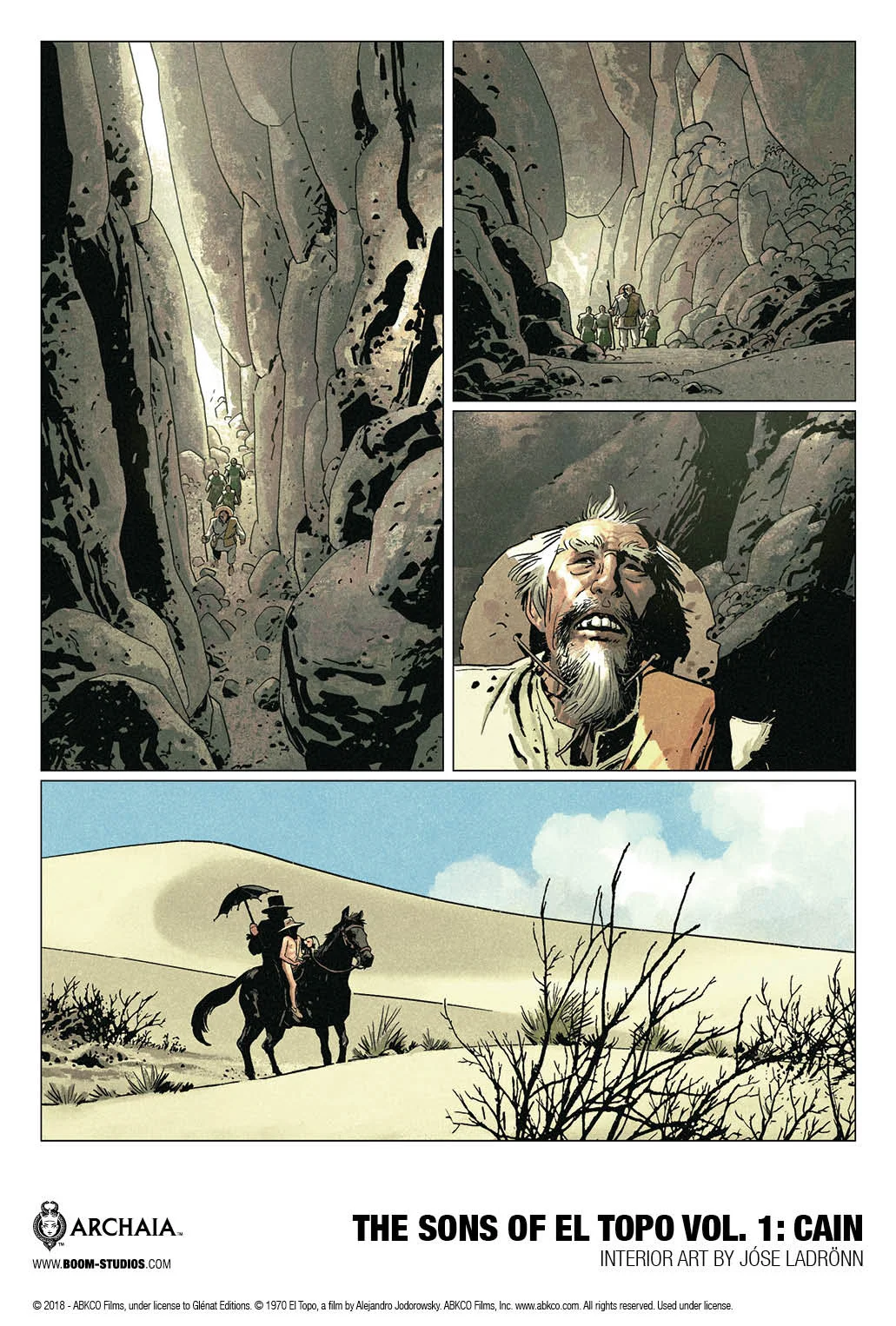
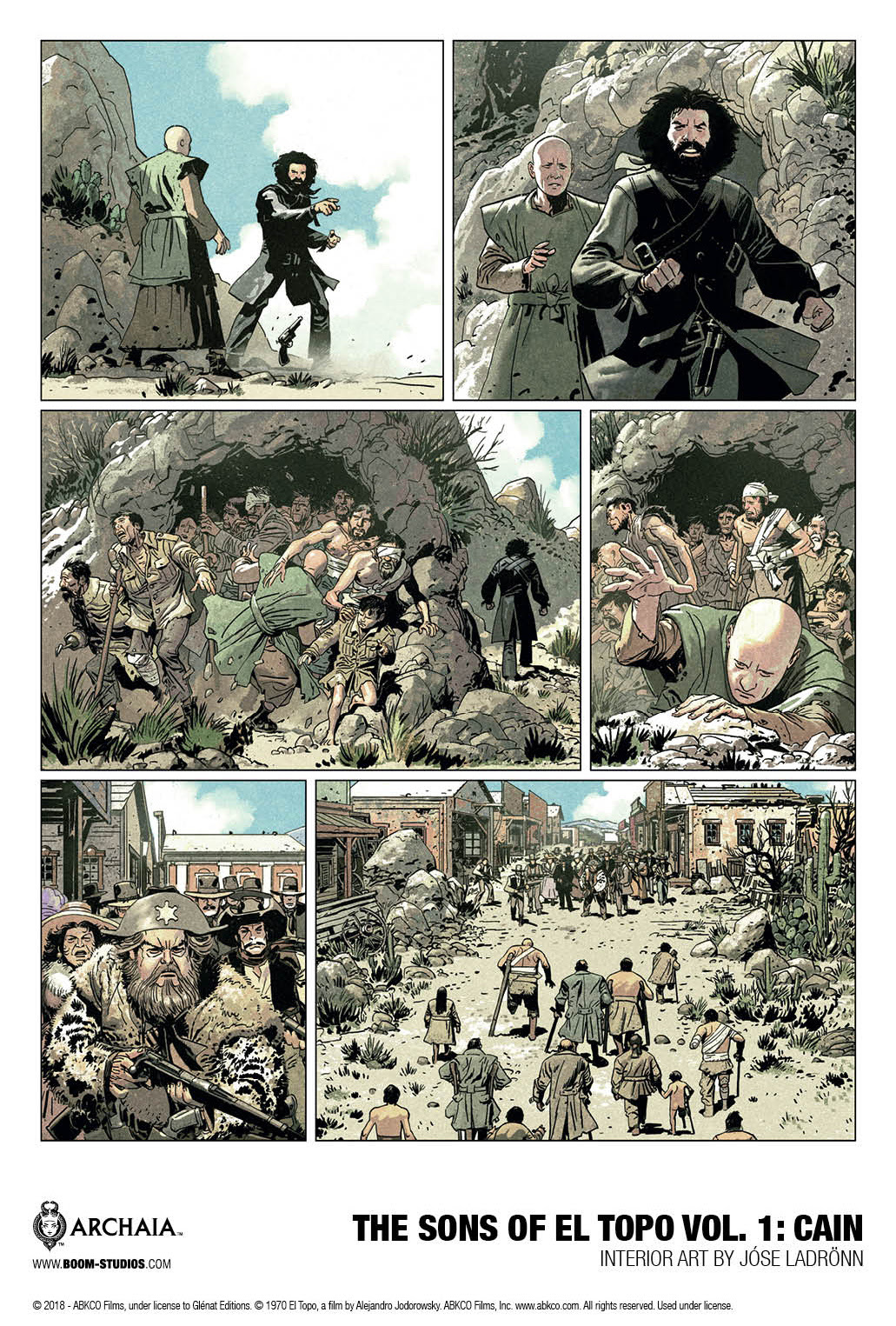
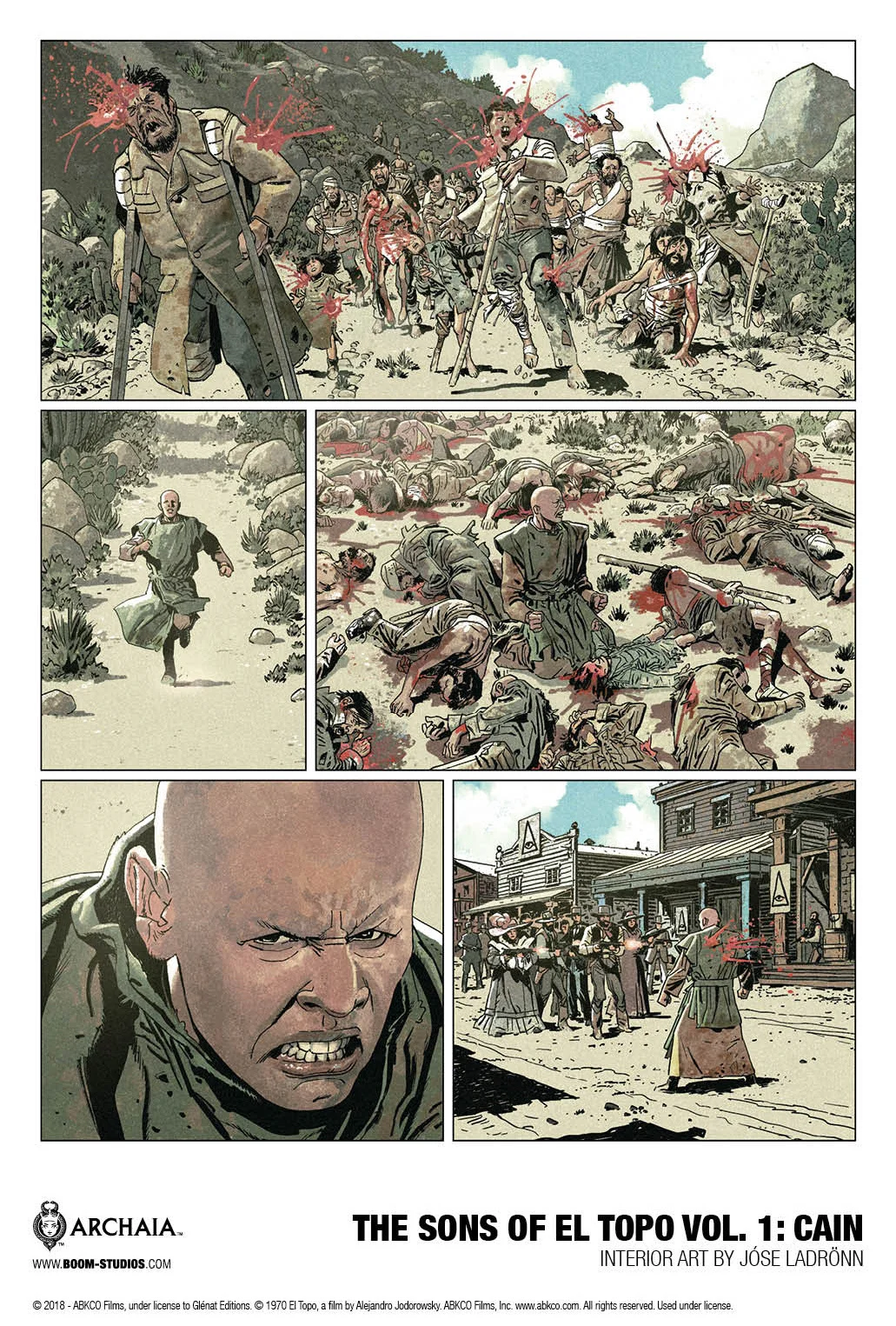
The Sons of El Topo Volume One: Cain OGN
Writer: Alejandro Jodorowsky
Artist: José Ladrönn
Publisher: Boom! Studios
More Info: December 2018
This is a hardcover original graphic novel from legendary filmmaker Alejandro Jodorowsky (Dune) and virtuosic illustrator José Ladrönn (Incredible Hulk) that continues the 1970 Mexican Acid Western film written, scored, directed by and starring Alejandro Jodorowsky himself. This sequel, arriving in stores December 2018, tells the story of El Topo—a bandit without limits and a man with no moral compass. But when his journey through the arid west brought him face to face with a series of rogue outcasts, he found enlightenment in the unlikeliest place and was forever transformed, becoming a holy vessel imbued with the power to perform miracles. This was a journey that took him far from his first born son, Cain, and brought about the birth of Abel.
Our Take: We love Jodorwsky (as much for his films as for his candid appearance in the all-time great art documentary Jodorwsky’s Dune), and while this presumably means an end to any chance of Jodo making a cinematic sequel to the first film, his comics are always imaginative and worthwhile. Oh, and the Ladrönn art is is just stellar.

Blackbird #1
Writer: Sam Humphries
Artist: Jen Bartel
Publisher: Image Comics
More Info: $3.99 / 32 pages / Oct. 3
An all-new ongoing series from fan-favorite writer SAM HUMPHRIES (Harley Quinn, Nightwing) and red-hot artist JEN BARTEL! In this neo-noir fantasy, Nina Rodriguez is positive that a secret magic world ruled by ruthless cabals is hiding just beneath the veneer of Los Angeles. The problem: everyone thinks she’s crazy. The bigger problem: she’s not crazy—she’s right. Can she unravel the mystery before the Great Beast catches up with her?
Our Take: Oooooo, shiny. Sam Humphries sensibilities and Jen Bartel’s art are such a wonderful fit, and look how nice it is washed over with all that neon. We’re not entirely sure what neo-noir fantasy means, but it looks like we’re in for some big magic fight in hella trendy LA. So, that’s cool.

Bone Parish #2
Writer: Cullen Bunn
Artist: Jonas Scharf
Publisher: Boom! Studios
More Info: $3.99 / 32 pages / Aug. 29
As a drug made from the ashes of the dead continues to spread across New Orleans, the Winters family is forced to defend their turf from the encroaching drug cartels. But some mysterious deaths could threaten everyone in New Orleans...
Our Take: Cards on the table...we haven’t read Bone Parish #1 just yet, but it was one of those books that half our Twitter feed (roughly) turned out to tell us to read. So, we’re on board with that and we’ll get to it when we have chance, plus also this second issue, too.

Harbinger Wars 2 Aftermath #1
Writer: Matt Kindt
Artist: Adam Polina
Publisher: Valiant Entertainment
More Info: $3.99 / 32 pages / Sept. 26
The power's back online and the fighting is over... but who are the real victors of HARBINGER WARS 2, and what was truly lost in the carnage? For those who survived the terrible onslaught - and who must now witness the devastating aftereffects of their actions - will there ever be peace again? As the seismic summer event of 2018 comes to a close, Eisner Award-nominated writer Matt Kindt (X-O MANOWAR, ETERNITY) sorts through the rubble of the most brutal confrontation ever felt in the Valiant Universe - and discover what lies beyond the bloodshed!
Our Take: It’s all in the solicit, isn’t it? Who ARE the real victors? We’ve enjoyed this event quite a bit (more than most Big 2 Events, incidentally), and what kind of savage would read and like an entire event and bail for the aftermath? Not us….not us.

Valiant High #4
Writer: Daniel Kibblesmith
Artist: Derek Charm
Publisher: Valiant Entertainment
More Info: $3.99 / 32 pages / Aug. 1
Save the last dance! Homecoming is here! For the students of Valiant High - the super-powered preparatory academy where tomorrow's heroes learn what it takes to save the world - that means that the biggest night of their young lives is almost upon them...and that the Immortal Enemy is finally ready to make his move! But as Faith, Colin "Ninjak" King, Peter Stanchek, and Amanda "Livewire" McKee try to stir unity amongst their classmates, can teamwork triumph over ancient evil? From rising star Daniel Kibblesmith (Lockjaw) and Eisner Award winner Derek Charm (Jughead), this side-splitting, all-ages reimagining of Valiant's greatest heroes is going out in style!
Our Take: Save the last dance, indeed! Like the Harbinger Wars 2 event serving as a refreshing alternative to Big 2 events, this 4-part series has been a refreshing proximation of Big 2 fun and irreverent character takes. Kibblesmith is pretty funny guy, both in terms of writing comics and on Twitter, too.

Zack Quaintance is a journalist who also writes fiction and makes comics. Find him on Twitter at @zackquaintance. He lives in Sacramento, California.
The Infinite Crisis of Being a Helena Wayne Fan

With DC’s Doomsday Clock halfway finished—and potentially serving as a re-instatement vessel for the Justice Society of America plus other DCU characters—we turned to Diane Darcy, likely the foremost expert on Helena Wayne, who details the history of her favorite character and why she should return.  

By Diane Darcy — I’ve made no secret that I’m a huge fan of Helena Wayne (see my blog, Tumblr, and Twitter), and today I’d like to share my interest with all of you. Let’s start at the character’s beginnings: Helena Wayne was created by Paul Levitz, Joe Staton, and Bob Layton in 1977, originally conceived as the daughter of the Golden Age versions of Batman and Catwoman—a very intriguing background from which to build a character—and as a member of DC’s original superhero team, the Justice Society. She is, essentially, a character built upon DC’s Golden Age lore.

Helena Wayne’s Relationships

In the Bronze Age, The Huntress and Power Girl together were a second generation World's Finest team.

People are often defined by their relationships and Helena Wayne is no exception. Her most significant are her friendships with the Earth-2 versions of Kara Zor-L (Power Girl) and with Dick Grayson, the original Golden Age Robin who continued with that identity into adulthood.

With Power Girl, Helena provided a contrast to Kara’s outspokenness, impulsivity, and more assertive personality, but she also loved and respected Kara for those same qualities. Kara connecting with Helena in a meaningful way created character development opportunities for both women, effectively allowing them to cement their place as the second generation World’s Finest team.

With Dick Grayson, Helena provided a different contrast. Whereas Dick maintained unwavering loyalty to her father—never challenging Bruce’s authority—Helena didn’t hold her father on the same pedestal. When she felt her father stepped out of line, she refused to accept it. She either challenged his authority or worked to diffuse the situation another way. We saw this most notably in All-Star Comics #69 and especially in America vs. the Justice Society. When it came to Batman’s legacy, Dick considered it his responsibility to continue his mentor’s work as Batman, whereas Helena felt she could more meaningfully carry on that legacy on her own terms as Huntress.

Part of what makes classic Helena Wayne such a compelling character is her status as a superhero and a working lawyer.

Helena Wayne and the Crisis on Infinite Earths

Apart from Helena’s time as a caped crusader, I found her civilian life just as interesting. When she wasn’t fighting the good fight as Huntress—or stopping major crises with the Justice Society—she had a day job as an attorney, which also created interesting conflicts. She had a stronger preference for her work as the Huntress and often found it difficult to balance that with her day job. Her double life also created relationship problems with her boyfriend Harry Sims, who was Gotham’s District Attorney.

This was all established in Helena Wayne’s first eight years of publication, and writers used it to tell incredibly fun stories that went in interesting directions. You can imagine then how devastating it was when she was one of the characters sacrificed in DC’s Crisis on Infinite Earths reboot in 1986, later to be retooled in 1989 as Helena Bertinelli, the character we know as The Huntress today.

Helena Bertinelli

While not a bad character, there's no denying that apart from physical appearance, nothing of the original Helena Wayne Huntress survived via Helena Bertinelli. She was completely retooled. In fact, by the time DC reinstated the Wayne origin two decades later (during Flashpoint) we still ended up with a completely different character. Post-Flashpoint, Helena Wayne had a new origin and the same post-Crisis Helena Bertinelli personality. Also, her relationships with both Power Girl and Dick Grayson were profoundly changed.

Between two cosmic reboots, Helena Wayne moved further away from the compelling character Levitz, Staton, and Layton created in 1977, and her situation was made all the more complicated by being retooled into Helena Bertinelli post-Crisis.

Part of the promise of Rebirth and Doomsday Clock, however, has seemed to involve restoring all of DC's characters to their iconic statuses. What, then, would DC need to do with Helena Wayne to restore her to her original compelling stature while also saving her future? I have a few recommendations…

Four Ways to Fix Helena Wayne

Classic Helena Wayne as The Huntress contemplates crime and its causes in South Gotham City.

1. Make Helena Wayne and Bertinelli Separate Characters

Step one is to stop treating Helena Wayne and Bertinelli as the same character with two different origins. They are—at their cores—profoundly different. They are two very different women with different backgrounds and significantly different motivations.

Helena Wayne became Huntress to honor her family legacy. Helena Bertinelli, meanwhile, became Huntress as a way to reject hers. Essentially, Helena Wayne embraces where she comes from and Helena Bertinelli does not. Helena Wayne is a legacy heroine whose core values and motivations are shaped by her upbringing as the daughter of Bruce Wayne and Selina Kyle. Helena Bertinelli is a tragic heroine with a conflicted identity, molded by Italian-American heritage, her Catholic identity, and her roots within a crime family.

Quite literally the only thing Helena Wayne and Helena Bertinelli’s origins have in common is they both became Huntress after seeing their parents killed. The reasons and circumstances that led to the deaths, however, are still profoundly different, inevitably sending them on very different paths with different potential for stories. Simply put, Helena Bertinelli—while still a compelling character—does not satisfy the needs of Helena Wayne fans anymore than Wayne does Helena Bertinelli fans. The answer is to let these two women co-exist separately.

2. Reinstate Helena Wayne’s Pre-Crisis History

Maintaining Helena Wayne's legacy and motivations for fighting crime is vital to ensuring she remains a compelling character.

In post-Flashpoint continuity, a version of Helena Wayne was created in which she served as Robin. While it was cool to see what Helena as Robin looked like fighting alongside her parents, this is better as an Elseworlds or What If story. Making her Robin changes too much of her character.

In pre-Crisis continuity, Bruce and Selina marry only after reflecting on their lifestyle choices and concluding they were not happy with where their futures were going. They also reflected on who they were as people, realizing that Batman and Catwoman were outlets for pain, not true identities. When they became parents, they retired their costumes to give their daughter a normal upbringing. Making Helena Robin changes Bruce and Selina from responsible to irresponsible parents who brought their daughter into their dangerous lifestyles—a regressive change.

Making Helena Robin also drastically changes her motivation. Pre-Crisis, Helena became Huntress both in response to her parents' deaths and in response to their legacies. She felt that with the upbringing she had, she had a stronger chance of making a difference in Gotham as the Huntress than as a lawyer in a courtroom. Why wait for a crime to happen when she could actively prevent it? The decision to become a costumed hero was entirely her own. It was very powerful. As Robin, the decision was made for her by her parents when she was a young age.

Finally, it’s simply more interesting having Helena Wayne as a Harvard graduate and a successful lawyer. She just has so much more agency than if you make her yet another sidekick whose choices were made for her while she was a child. Seeing Helena try to balance her life as a lawyer and as the Huntress created a conflicting and compelling dichotomy that affected her most intimate relationships.

3. Reinstate Her Original Identity, Personality, and Relationships

Speaking of her identity and relationships, the change I want most is to see them reinstated. I love when Helena Wayne’s Huntress showcases her detective skills, combat training, and, of course, her signature pistol crossbow, but her civilian identity is just as important. It’s the Helena Wayne side of that Huntress that most strongly attracts me to her character vs. Helena Bertinelli when she occupies the same costume.

What makes the Helena Wayne identity so special? It goes back to what I said at the start. She is the daughter of the Golden Age Batman and Catwoman, and she originated the Huntress identity as a way to continue their legacy. In being the original Huntress, she even provided the base template for Helena Bertinelli. (I always think of Helena Wayne as the Jay Garrick to Helena Bertinelli's Barry Allen.)

I also like the fact that she is a lawyer because it positions her as a working woman who earns her own money as opposed to living on her family's fortune. She even differs in this way from her father, who seemed to spend more time fighting crime as Batman than working a real job. (Golden Age Bruce started working a real job after he retired his Batman lifestyle.)

On the personality front, pre-Crisis Helena Wayne was never a dark and brooding heroine. Even when she experienced low points in her life, she still maintained a high level of self-confidence, which always spoke to me. She remained happy and optimistic in the face of grave troubles, which is another way she differs significantly from Helena Bertinelli.

While not as important as her relationship with Power Girl, Helena's friendship with Golden Age Dick Grayson is also worth revisiting.

What was also vital to her personality was her relationships, which brings me to another vital point—Helena Wayne needs Power Girl in her life and vice versa. They enrich each other's lives by being the legacies of the Golden Age Batman and Superman, and their friendship also makes their tragic circumstances a little less sad. If Power Girl in particular is going to return to her status quo of being the Earth-2 survivor of the Crisis reboot (a development we’ve seen hints of), having Helena is vital.

Another relationship that would definitely enrich Helena's life on the main Earth would be rebuilding her friendship with Dick Grayson. Even though Nightwing is a different character from the guy she knew as her big brother on the original Earth-2, the Prime Earth Dick still embodies the charm and appeal of the Golden Age Robin (perhaps with a better fashion sense). Of course, DC could also just retcon the current Earth-2 Grayson back into the pre-Crisis original and settle for having two Dicks on the main Earth instead of one. I mean, why not? We already have two Wally Wests. Just let the Earth-2 guy grow a beard and call him Richard. But I digress…

One more classic Huntress panel for the road...

4. Return Her to the Justice Society

Last but not least, reinstate Helena’s membership into the Justice Society. The Justice Society was her superhero family from the beginning, and putting her back on the team would allow her to reclaim her place within DC's Golden Age lore. She was always a character built on that history. Now we have a main Earth that erases the Trinity from the Golden Age, but putting an Earth-2 Helena Wayne Huntress alongside Power Girl, along with Lyta Trevor as Fury, would help make up for that.

I am, however, a realist, and I know it is unlikely that any of the things I want to see happen for Helena Wayne post-Rebirth will actually happen. If there is, however, a creator or editor at DC who’s thinking of Helena Wayne fans (like me), we’d absolutely love to see the classic character return. Her existence would benefit other characters in the DCU, and, most importantly, she is still so ripe with the potential for good stories.

Click here for a reading list of comics starring Bronze Age Helena Wayne.

Diane Darcy is a huge fan of Bronze Age DC, Earth-2, the Justice Society, Power Girl, and especially Helena Wayne as the Huntress. When Diane isn’t obsessing about comics, she enjoys music, writing, animals, and researching exoplanets, multiverse theories, and time dilation. You can find her at @HelenaWayneBlog

Rogue and Gambit in Love: A Look at the Iconic Couple's First Appearance

By Theron Couch — A bad drink is often saved by the right chaser. In fiction, happy endings make great chasers, able to cleanse and forgive any unpleasantness in the story that came before. Rogue and Gambit, after years of will-they-won’t-they tension, took a major step forward in their relationship in the recent Rogue and Gambit mini-series, before finally hitting real pay dirt with their spontaneous wedding in X-Men Gold #30.

As if all that wasn’t enough, though, now they’re headlining a brand new series that starts Wednesday, Mr. and Mrs. X by Kelly Thompson and Oscar Bazaldua. This happy ending is one hell of a chaser, one that forgives a series of past missteps related to how these two have been depicted, including villainy, underdeveloped characterization, and an arguably disturbing first meeting between them. It’s that first meeting—as well as the first appearances of each character—that I'd like to discuss today.

Rogue’s First Appearance

Note how the cover teases a shocking mystery guest!

Rogue’s first appearance was Avengers Annual #10, and there was very little in that book to indicate she would spend decades as one of the most popular X-Men. Rogue shows up as part of Mystique’s Brotherhood of Evil Mutants in an issue that starts with Carol Danvers being found unconscious, thereby kicking off a mystery that culminates in a confrontation between the Avengers and Mystique’s aforementioned Brotherhood.

Before the main event battle, though, Rogue assaults the Avengers’ heavy hitters all on her own, using her powers without the restraint commonly seen in her X-Men years. Rogue single-handedly eliminates Captain America, Iron Man, Vision, and Thor. But for all that power, her place in the story is essentially just as muscle for Mystique’s team, with no real character development aside from use of her powers. As she flees at the end, there’s no suggestion of redemption in her future; Rogue’s first impression is that of a powerful enemy to be seen on a recurring basis.

Gambit’s First Appearance

It would have been hard to predict at the time that the mutant called Gambit! would both enter and stay.

Gambit, on the other hand, first appears as a hero. Sort of. Uncanny X-Men #266 opens with Storm in the custody of the Shadow King and his Hounds. Gambit is engaged in thievery at the mansion where Storm is being kept—a perfect setup for him to help her attempt an escape. This Gambit, however, is a man of few words, lacking the flirtatiousness that later becomes a hallmark of his depictions.

When Gambit chooses to help Storm, it’s not because she’s an X-Man or a mutant, but rather because he suspects that she is Ororo Munroe, herself a famous thief. In this issue Gambit is little more than a cipher. The reader is given no special reason to care about this new character—except, perhaps, that he’s an active thief; Storm could have been rescued by anyone. Mutants come and go in X-Men, and there is nothing in Uncanny X-Men #266 to suggest Gambit would stick around.

Rogue and Gambit in Love

Mr. and Mrs. X (out July 25) looks to be a sweet chaser to one of the most famous-yet-tumultuous romances in the X-Men world.

Over time—and despite mutually rough beginnings—both Rogue and Gambit find a home on the X-Men, and eventually their characters are fleshed out. Being on the same team, it’s only a matter of time before the two start appearing together. Their first interaction takes place in the Chris Claremont and Jim Lee X-Men #1 and their romance begins in X-Men #4, several years after Rogue’s first appearance and roughly one after Gambit’s. To have a romance start so quickly, one can only assume it was love at first sight.

Well, it was something at first sight, if not exactly love.

In the recent Rogue and Gambit mini-series, it is revealed the couple actually first became entwined during the Muir Island Saga—which pays off machinations at work in Gambit’s first appearance. The entire X-Men team is on Muir Island during Uncanny X-Men #278 - 280, and the Shadow King has taken control of all of them. To avoid spreading himself too thin, those in the Shadow King’s thrall are free to act on their own when he isn’t in direct control. Their personalities, however, are dark and violent reflections of their normal selves.

These are the conditions under which Rogue and Gambit first meet, according to Rogue and Gambit #2—first meet and, it’s suggested, first make love. On the surface, the encounter can be see as one of simple lust and little more—but not to Gambit, who points out that even under mind control the two were drawn together. And maybe he's right, because they did start their little dance soon after.

Ultimately, Rogue and Gambit have experienced almost every permutation possible both as individuals and as a couple. Their fictional history began in a much different (and darker) place than where we find the couple now. In some ways, this makes their wedding the best happy ending of all. Rogue and Gambit have never quite forgiven themselves for what they’ve done. Perhaps they never can. But if a marriage is a leap of faith, maybe the message is that they each forgive the other, even if they can’t forgive themselves. Anyone who’s followed their histories knows that Rogue and Gambit have often been a rough drink. In that regard, Mr. and Mrs. X looks to be one hell of a chaser.

Theron Couch is a writer, blogger, and comic book reviewer. His first novel, The Loyalty of Pawns, is available on Amazon. You can also follow him on Twitter at @theroncouch.

On Writing Lois Lane: The Significance of an Icon

By Maya Kesh — Since Lois Lane first debuted in 1938’s Action Comics #1, right alongside Superman and Clark Kent, she has been a lightning rod for how society views strong women. Through the years, this significance has been a double-edged sword, with Lois’ characterization reflecting both progress and limitations in various eras. As the Superman comics pass to a new writer this summer amid much media coverage and fanfare, I think it’s important to look at how Lois has been written historically, what it means to write her well, and why her depiction is so important for Superman stories.  

Lois Lane Through History

In the early Golden Age comics (1938 - 1955), we see Lois Lane very much steeped in the working dame mode of that era. This is familiar to us through old movies like His Girl Friday.

In the Silver Age (1956 - 1970), Lois becomes a caricature of this idea, a desperate career woman who needs to marry to be happy. Lois having an end goal of marriage isn’t a problem, but it is a problem how that end goal is defined, as if when she marries Superman, she will have achieved the sum of all her ambitions. Marriage basically became an obsessive goal, one that wasn’t portrayed sympathetically at all.

Next came the Bronze Age (1970 - 1985) and the women’s liberation movement. During this time, Lois was seen through those changing progressive attitudes. Groovy, right? I am woman hear me roar. She was navigating slowly-evolving attitudes toward women in those years.

Wife/Mother vs. Career Woman

In the Modern Age, we’ve come to another turning point for Lois. She’s currently married to Clark, and they have a son, Jon. There has been a lot of discussion lately about what this means for Lois Lane, and it often comes back to this idea that being married to Clark and raising a child somehow limits her character.

This begs a question: Why? I think it goes back to the Silver Age idea that marriage is somehow an end for her. If she’s married, she can’t be everything she could be. That notion, however, brings us to another question: Are husbands and dads primarily defined by those roles, too? Or, are they written as multifaceted complex characters who are able to be many things to many people? The answer to the second question is decidedly yes. They can be career men (which isn’t even something men are called), as well as husbands and fathers. Women, however, are still often defined by stereotypes within labels, as if Lois Lane being a career woman means that she can’t also be a mother and a wife.

When Lois is written as a mom, for example, there is this idealized version of who mom is. And usually in the Superman-verse, this means Martha Kent, the stay-at-home mom who kept house and baked pies. Trying to fit Lois into that mold means writing her in an inorganic way that belies her personality. One’s personality doesn’t change after you have kids—my own teenagers can attest to that. Do priorities change, though? Of course.

Being a mother, however, shouldn’t turn Lois into Martha Kent. They’re entirely different people, and Lois doesn’t have the same skillset Martha does, nor does she need it to be a good mother. Basically, Lois might not be able to bake a perfect pie (although Clark probably can because he grew up with Martha as his mother), but she may be better-able to show her son how to pick a lock or hotwire a car if he ever loses his keys. This doesn’t make Lois any less of a mom. The definition of mother/wife should broaden to include all types of people. Just as dads are not inept stereotypes, neither are moms an idealized throwback to Leave it to Beaver.

In general, I think Lois often suffers from baggage writers bring when they think of her character throughout history. Some remember her as the abrasive pest she sometimes devolved into in the Silver Age, never mind that Superman was just as culpable at that time (so much so a site was dedicated to his Superdickery). Some seem to remember her as a man-hungry husband hunter, or as somebody who only loves Clark’s powers (I’d argue she always loved the man behind the disguise, no matter which persona that was).

How to Write Lois Lane Well

It sounds simple, but I think this bears emphasizing: to write Lois Lane, it is important to know who she is and the traits that have long defined her. Lois is strong, tenacious, compassionate, and ethical. She also wears her own masks. She’s vulnerable but doesn’t want the world to see it. Lois is fiercely dedicated to truth and justice, using journalism as her own superpower. She also understands there are shades of gray. Truth isn’t binary. There are some truths worth protecting from the public.

Clark’s identity, for example, isn’t for public consumption, as it doesn’t have any bearing on public welfare. There are, however, lies that exist to destroy people (ahem, most of what Lex Luthor does), and she is out to expose people who hurt others as they quest for power.

There are recent examples of Lois being written this way. This scene from Mark Waid’s Birthright shows us a Lois who stands up for injustice no matter where she sees it.

And this scene from Kurt Busiek’s Action Comics #850 shows us Lois’s early days with Clark. It’s a great example of how to write the triangle for two while giving empathy to both players, rather than turning Lois into an unsympathetic person only interested in Superman and his powers.

These are just two examples. Teenage Lois in Gwenda Bond’s young adult Lois Lane prose trilogy also gives us a multifaceted portrayal. In live action, for all of Smallville’s ups and downs, the TV show ultimately captures Lois’s complexity pretty well.

In the end, I think it’s important to remember Lois Lane was originally created alongside Clark Kent and Superman for a reason: she provides the audience with a narrative bridge between his identities. Through Lois, we as readers see the wonder that is Superman, while we also see the everyday life of Clark Kent—a dichotomy filtered through one character to create a consistent perspective.

This all speaks to why I believe it is so important for Lois to be written well, because it is through her that we gain access to all that is Superman. When Lois is allowed to reach her potential? Superman stories truly soar.

Maya Kesh is a lifetime comic reader and a writer whose articles often focus on how women are portrayed in comics. You can follow her on Twitter at @mayak46.

Amazing Spider-Man #1 Brings the Funny: A 5-Panel Explainer

By Zack Quaintance — The with great power comes great responsibility ethos of Amazing Spider-Man is almost universally relatable, especially for middle class Americans who’ve had even minor opportunities. It definitely resonated with me as a kid in a blue collar suburb of Chicago. The sum total of my power back then was manipulating my brothers into unholy pacts to combine birthday money for new video games. Yet there I was, reading ASM and nodding along, like, This story gets me.

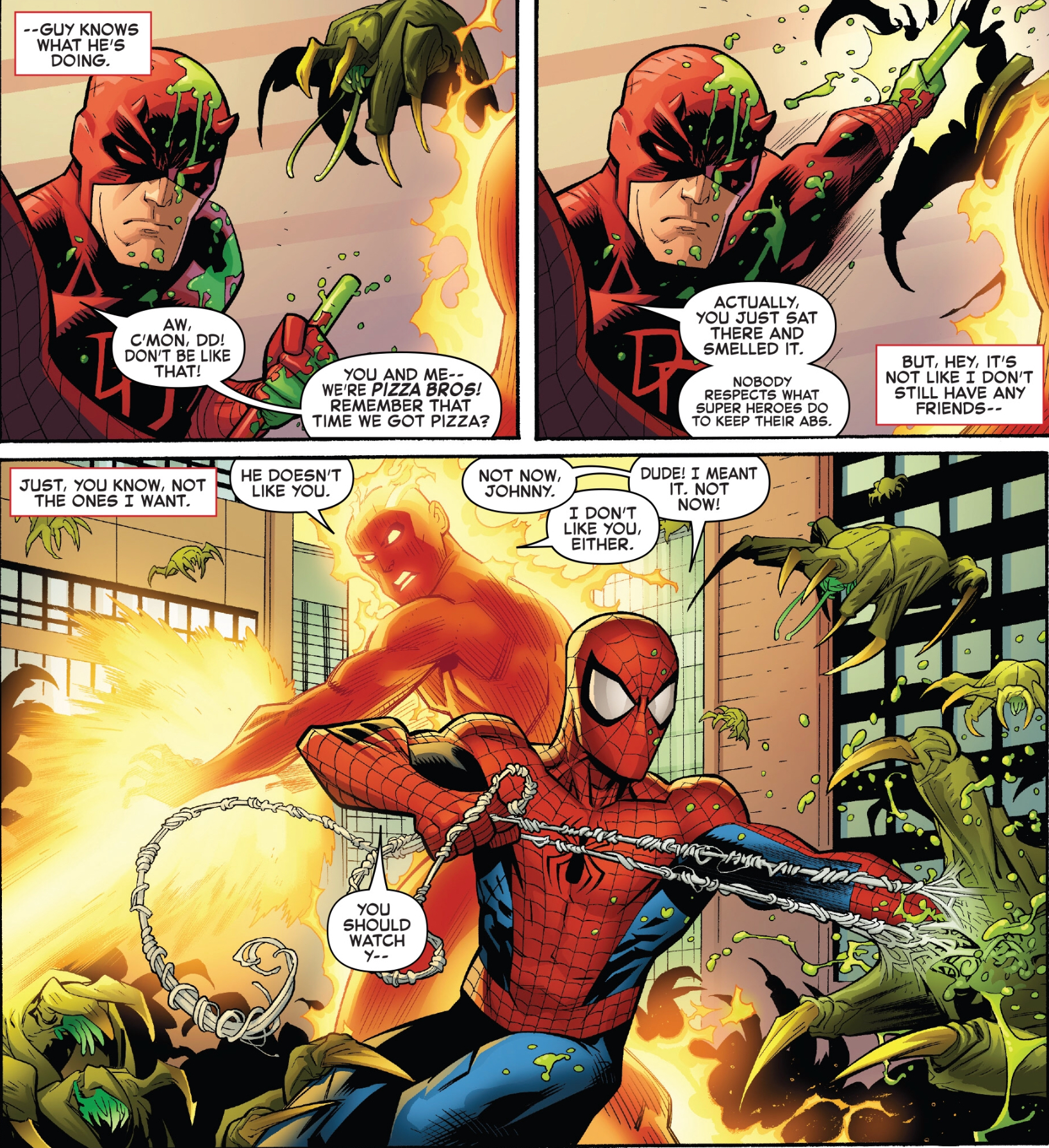
That deeper meaning, however, was only half of why I loved the comic. I was also there because Spider-Man’s jokes were funny. Last Wednesday, a new team of writer Nick Spencer and artist Ryan Ottley took over Amazing Spider-Man (we loved the first issue), and while a more holistic view of their run will ultimately determine whether they do justice to that ethos, it’s immediately clear the humor is on point. I, for one, chuckled while reading...chuckled!

Anyway, today we're looking at five funny panels from Amazing Spider-Man #1. It’s not as insightful as some other recent Tuesday analysis pieces (ahem, see this thing about Deathstroke, please!), but like Spider-Man, we are also here to bring some funny (plus we're at San Diego Comic Con next week, so we have to do five day's worth of posts this weekend).

Let’s do this!

Panel 1 - Kiss B-Sides

The previous Amazing Spider-Man writer, Dan Slott, had a good sense of humor, to be sure, but you try writing 10 years worth of quips for the same voice and see how your results are toward the end. What struck my as different about Spencer's humor right away was how it extends past Spider-Man to include jokes at the expense of or said by other heroes in the Marvel Universe.

Take, for example, this excellent bit with the Guardians of the Galaxy. The writing here is funny, first as the Guardians banter and Groot lets slip something speciesist, and next as Hawkeye (a quippy fellow himself) mocks the way '80s music has become part of the Guardians' DNA via their depiction in the movies. 

Panel 2 - Workshopping Jokes

This was a nice little set them up and then knock them down kind of joke, wherein Spider-Man admits to workshopping past jokes to evaluate whether they're fit to be used again (although his ability to perceive their reception is a little questionable). Oh and stick with this, it's a long one...

Panel 3 - Doom-ocracy

In the (almost) words of the immortal Kent Brockman of The Simpsons, if Doom has said it before, he'll say it again...democracy simply doesn't work.

Panel 4 - Pop Culture

Now, I'm not saying that Spidey should become Deadpool (oof, no thanks, one is enough), but it's nice when his books have a little pop culture perspective in them. There's this quote—and I can't remember its exact wording nor who said it—and its gist is that comics are sort of a fast and immediate reflection of the pop culture zeitgeist at any given time (ignore that the panel below quotes dialogue from a movie released in 1977, please!). 

Also, I for one have always been curious about how superheroes manage to find the time and nutritional obsessiveness to stay in such great shape. Nice to get a little nod to that here.

FullSizeRender.jpg

Panel 5 - The Magic Chair

This is absolutely the bit that made me chuckle. It should be noted that while I've placed these disembodied panels beside each other, this third panel is separated from the first one by quite a bit of narrative, making this joke what we who have listened to podcasts about the business like to refer to as a call back. 

Peter loves his chair.

Peter loses his chair.

Peter's chair (much later) finds a good home.

But Not So Fast

This is the part of this feature wherein I take a step back to taper my excitement. I must admit, however, that it's pretty challenging here. Spencer and Ottley's Spider-Man isn't yet demonstrably superior (heh) to Slott's. It's been one (very very very good) issue for them, while Slott did his thing with varied level of success for almost 10 years. So, I guess I'll pump my enthusiastic brakes here a moment by noting that they need to show they can perform at this high a level for more than just one outing.

Still, what a great start for the new team. It's a comic review cliche in an industry that runs on nostalgia, but this really is much closer to the Spider-Man stories I remember reading and watching when I was a kid. 

Zack Quaintance is a journalist who also writes fiction and makes comics. Find him on Twitter at @zackquaintance. He lives in Sacramento, California.
Wonder Woman: The Hiketeia…A Greek Tragedy Told in Comics

The physical battle between Batman and Wonder Woman in this story is less meaningful than the ideological conflict.

By Taylor Pechter — “…But all tragedies end the same way…”

This is the theme that permeates the 2002 original graphic novel Wonder Woman: The Hiketeia, scripted by Greg Rucka, illustrated by J.G. Jones & Wade Von Grawbadger, and colored by industry veteran Dave Stewart. It’s a story told in comic form, yet it possesses many of the essential elements of a modern Greek tragedy, including impossible situations and a heartbreaking downfall.

This story follows Wonder Woman/Diana Prince as she becomes honor-bound to a woman named Danielle Weelys through the ritual of Hiketeia, an ancient tradition from Greece in which a poor or destitute individual supplicates oneself to a wealthy benefactor who must then protect them. If either the supplicant of supplicated disobeys the commitment, the Furies come to inflict punishment. From here, we enter Diana’s story.

Our narrative starts at its end. Diana is Themyscira’s ambassador to Man’s World. As she stares out her window at the Erynies or Furies, she recalls all that transpired to lead her to this moment, as well as how it could have been different. We transition then to three weeks ago in Gotham City, where for the first time we see the character Danielle. We know little about her at the start, save that she hunts down and ultimately murders a man. She is then confronted by Batman, who for all intents and purposes is the villain of this tale. A chase ensues, and Danielle throws herself into Gotham Harbor. She then supplicates herself to Diana using Hiketeia, thereby setting into motion our central ideological conflict.

Again, Batman is unofficially the villain of the story. What Rucka does more than anything in this story is contrast Diana’s sense of duty and honor with Batman’s sense of justice and righteousness. This ideological conflict drives the story as Danielle eventually becomes caught between her loyalty to Diana and her own sense of justice.

In a very emotional scene, we watch as Danielle explains her story to Diana, who uses the Lasso of Truth to extract it. We learn about Danielle’s younger sister, Melody, who moved to Gotham City from Webster Groves, Mo. to try and make it big. Insidious Gotham, however, swallowed her: she was taken advantage of, raped, and later murdered. It is here Rucka deconstructs modern day American society: we see police finding a needle that was used to drug Melody during her assault and making immediate presumptions, ultimately labeling her just another junkie whore…all of which Danielle describes.

Batman's hard-line stance against murder puts him into conflict with Wonder Woman, who is honor-bound to protect a woman who kills to get justice for her lost sister.

Danielle subsequently sets out to get justice for her baby sister by killing the men who hurt her. This revelation does not hasten Diana’s resolve to protect Danielle—it doesn’t need to, as they are still bound by the ritual. Soon a second confrontation with Batman occurs, wherein Danielle defends her actions to the Caped Crusader. Danielle’s predicament is much like the old paradox of a poor man breaking into a pharmacy to get medicine for his sickly family…is he wrong because his actions are against the law, or is he right because he is doing what is best for him and his family? Is Danielle right for murdering those men because they did the same to her sister, or is she motivated by selfish vengeance? This is the paradox. While Wonder Woman is forgiving of Danielle’s situation, Batman is not. As we all know, Batman’s views on killing—even when killing seems more than justified—are quite staunch.

We now reach the climax of the story, as the ideological tension between Diana and Bruce finally builds into a fight. This fight is a footnote, however, with Diana making quick work of her mortal foe. Batman tries to appeal by supplicating himself, but Diana denies the request. In the commotion, however, Danielle runs. With the Erynies whispering in her ears, she leaps off a balcony onto the rocks below. As the book draws to close, we see Diana in contemplation again—much as we did at the start—wondering: Why is Man’s World so cold…It was never this cold on Themyscira.  

With Hiketeia, Greg Rucka weaves a quintessential Wonder Woman tale. We see Diana struggle with Man’s World and her obligations, as well as with her own sense of duty and honor. It creates a poignant contrast with Batman’s own sense of justice, which has been explored time and again in comics, leading to a central conflict that is engaging and emotional. J.G. Jones pencils and Wade Von Grawbadger’s inks infuse this story with both bleakness and hope, while Dave Stewart’s hues give it added weight.

Following Hiketeia, Rucka went on to write two critically-acclaimed Wonder Woman runs (one that began in 2003 and lasted for three years, and another that started with DC Rebirth and ran for 25 issues), solidifying himself as a preeminent voice for not only Diana, but for female superheroes in comics.

Taylor Pechter is a passionate comic book fan and nerd. Find him on Twitter @TheInspecter.

Priest’s Deathstroke: An Epic of Fatherhood and Regret

From the start, Christopher Priest's run on Deathstroke has been about fatherhood and regrets.

By Zack Quaintance — This week’s Deathstroke #33 made absolutely clear what writer Christopher Priest’s run on this book has long been about: regret and fatherhood. The comic’s current arc posits Damian Wayne may be the son of Slade Wilson Deathstroke, rather than Bruce Wayne Batman. The truth is foggy (and probably doesn’t matter), but in searching for answers, Damian joins with Slade, subsequently ushering in a poignant moment of growth for our central character, which is what we’re looking at today.

See, even now Slade continues to insist any involvement with Damian is because the boy can help with the only thing that matters to him: working as a mercenary/assassin. This is telling. Throughout this run, Slade has taken the same attitude toward many youngsters, some of whom are biological children and some of whom are surrogates (more below). This time, however, something changes.

Ed Benes expertly illustrates the regret on Slade's face as he sleeps atop a gun that serves as metaphor for his violent lifestyle.


Wintergreen—arguably Slade’s only real friend—guilt trips him about Damian, telling him the boy is...grandson of Ra’s Al Ghul—raised by the League of Assassins...his own mother had him killed once, Slade...this is a severely damaged young boy. We don’t see Slade react, not immediately, but artist Ed Benes soon illustrates a closeup of Slade’s concerned face, his head on a pillow with a gun beneath it as young Damian intones rhetoric about being a warrior, sounding both traumatized and borderline insane (standard for Damian, but still…).

There’s a clear implication: Slade is recalling past kids who’ve been damaged in his care, as far back as his first fight with the Teen Titans (which is in continuity again?). Protecting children—or failing to—has been central to Deathstroke from his start, and so Priest logically centers this run on the deaths, losses, disillusionment, all of which is traumatizing, even for one as hardened as Slade.

Change, however, does occur. When Damian is nearly lost in a magical shadow realm that causes insanity (yay for superhero comics!), Slade hears echoes of Wintergreen’s words—this is a severely damaged young boy—and saves Damian. Got you! After so many failures—some due to selfishness, others to circumstance—it’s a powerful moment of growth. It’s also expert storytelling patiently executed by Priest. So, with that in mind, let’s look now at the narrative tools that helped build this payoff.

Man vs. Self: Slade Wilson’s Efforts to Deflect Emotional Damage

The simplest tool Priest uses is depicting Deathstroke as removed from the pain he has suffered. Essentially, Slade Wilson’s constant insistence that young people in his life mean less than nothing is an invincible Ikon suit for his feelings. Whereas the actual suit protects his body, his repeated insistence he doesn’t care protects his psyche, also distancing him from past regrets.

Slade is a cold person, to be sure. He kills for money, etc. Being emotionally removed is obvious. To flesh Slade out, however, Priest also cracks his exterior, putting hesitation or clumsiness near his worst moments, including when he alienates his young hero team Defiance (a who’s who of kids he’s failed), or when he contracts a hit to get closer to his estranged daughter. Priest puts in work to build a compelling dichotomy within Slade, showing rather than telling us he is conflicted by peppering subtle but consistent moments throughout this lengthy run.

The Kids in Deathstroke’s Care

Those aforementioned moments are best examined via the other kids involved with Slade before Damian, specifically by looking at how Deathstroke fails them each. They are..

The first panel of Priest's run: Slade's doomed son Grant in the cold, being cast away for weakness by his father.

  • Grant Wilson (biological son): It’s incredibly significant the first panel of Priest’s run (back in the Deathstroke Rebirth one-shot!) is Slade’s now-dead son Grant curled in a fetal position, cold and alone in a truck during a hunting trip. Slade bursts in and demeans the boy, the least grandiose of his failings. He’s just a bad dad, insensitive, uncaring, mean-spirited, but it creates an effective starting point for his hero’s journey. For full effect, compare Slade then to the man who saves Damian Wayne...powerful.
    How Deathstroke Fails Him: Slade’s cold (heh) parenting pushes Grant to run away, join H.I.V.E., and get superpowers that later cost him his life.

  • Joseph Wilson (biological son): Having the most interactions with Slade, Joseph (a.k.a. Jericho) also has the relationship that is arguably most complicated. Of all the kids in Slade’s orbit, Joey is possibly most like him, although obviously not as cold.
    How Deathstroke Fails Him: When Joey is young, The Jackal comes looking for Slade, finds Joey, and slits his throat. When he’s older, Slade sleeps with his fiance (it was complicated, but still…), and the list goes on from there.

  • Rose Wilson (biological daughter): Rose is the first character that causes a real crack in Slade, showing us growth from the painful mistakes made with his sons. His methods are clumsy, but, ultimately, Slade is trying to get closer to Rose.
    How Deathstroke Fails Her: He’s absent most of her life. As an adult, he puts a hit on her so they can investigate it together, assuming it won’t endanger her because she’s clairvoyant (but still…).

  • Wally West a.k.a. Kid Flash: Deathstroke comes into Wally’s life as a fatherly mentor, which makes sense because Wally’s own biological father was an actual villain.
    How He Fails Him: By letting Defiance fall apart, leading to an apparent suicide by Power Girl (more next). Basically, he was not a great mentor.

  • Power Girl a.k.a. Tanya Spears: Power Girl’s case is the saddest of this bunch. She has little else in her life, before being set upon by Slade, who oscillates wildly between helping her and needing help, misleading her throughout.
    How He Fails Her: Slade deceives her constantly, taking one redemptive step forward and two back, before putting her on a path to being lost in another dimension (I think?).

Christopher Priest’s Flashbacks

Time jumps are used to great effect throughout this Deathstroke run, using the past to convey Slade's interiority. 

Priest has a unique style, jumping fitfully through time. This is fairly common in superhero comics. Priest, however, uses more precision than most writers. If Deathstroke is consumed by regret over failing young people around him, his head would logically be in the past. There are myriad examples of how Priest shows this, but perhaps the most effective is in the Rebirth one-shot, wherein a man begs for life, telling Deathstroke, I have sons...and Slade hesitates, recalling the long ago hunting trip and his lost boy. It expertly sets the tone for how meaningful flashbacks will be moving forward, for how Slade’s past will inform his present and future for the next 30-plus issues.

Ultimately, it’s this flashback structure that is Priest’s most interesting use of graphic storytelling, deployed not just for exposition but to convey our hero’s interiority, especially in memories of that cold day Slade took his sons hunting, how he treated them, and how he could/should have been a better man. The setting is frigid and so is Slade, and as the story progresses, this significance becomes painfully clear in the context of Deathstroke’s flawed decisions.

The Future of Priest’s Deathstroke

Lastly, I'm predicting the Deathstroke vs. Batman arc is a finale for Priest’s run on this book (my predictions are always wrong, but still...). Issue #35 drops in September, concluding the Damian Wayne story while possibly bringing to a head all of Slade’s issues with fatherhood, responsibility, trauma. There’s an interesting mirror structure between Deathstroke #33 and Deathstroke #4, which share similar openings—Slade disguised on a road trip with a kid. 

The opening to Deathstroke #4.

The opening to Deathstroke #33.

Could the entire run be mirrored? Is it winding down the way it was ramping up the last time we saw this opening? We’ll see.I’ve said many times that I hope Priest gets a long character-defining strech on Deathstroke, a la Jason Aaron on Thor, but if this is how it ends, I’ll be satisfied with all he has accomplished. It’s so rare that a superhero (supervillain?) comic gets to show this many careful and quiet moments of hard-earned personal growth.

Zack Quaintance is a journalist who also writes fiction and makes comics. Find him on Twitter at @zackquaintance. He lives in Sacramento, California.

FLASHBACK: Amazing Spider-Man #1

At the time of the character's creation, there was little expectation that Spider-Man would be more than a fad.

By Theron Couch — Would you believe Stan Lee once wrote two stories for a first issue and couldn’t even keep his main character’s name straight? Such was 1963’s Amazing Spider-Man #1, which was published in a different era of comics. Back then, comics didn't tell the same sort of long-term stories that developed over years. The established pattern was fads. Readers would buy horror for a while, then westerns, then war, and so on. These fads came and went so often that few expected Spider-Man to last. Yet, here we are. Decades later and Spider-Man is Marvel's flagship character, a true icon despite his humble—almost rudimentary—beginnings.

This Wednesday, a new writer will takeover Amazing Spider-Man for the first time in roughly a decade, as the creative team of Nick Spencer and Ryan Ottley debuts on the title. In preparation, I'd like to look today at that same comic's very first issue. Amazing Spider-Man #1 tells two stories that effectively pick up at the end of the character’s first appearance in Amazing Fantasy #15. Uncle Ben is dead, and Peter feels a need to provide for Aunt May. Unfortunately, J. Jonah Jameson has, via newspaper editorials and public addresses, turned the public against Spider-Man. No one will pay him for performances. Amidst this, Jameson’s astronaut son is going into space in a new capsule. The guidance system falls off, and only Spider-Man can get on the capsule to reattach it as it plummets toward Earth. Peter is certain this act of bravery will show the public he is no menace, but Jameson twists events to blame the accident on Spider-Man.

The second story begins with Spider-Man breaking into Fantastic Four headquarters, hoping to show-off his abilities and get a paid position. Unfortunately, the FF don’t have paid positions, so Spider-Man leaves, which makes him vulnerable to a frame job by the Chameleon, who has stolen secret plans for the reds. Spider-Man, initially the patsy, saves the day, but this confusion further fuels public belief that he’s a menace. The issue ends with our hero wishing he’d never gotten powers.

Spider-Man as drawn by co-creator Steve Ditko was less muscle-bound than the version we often see today.

Today, Amazing Spider-Man #1 stands as a fascinating look at an iconic character’s past. Steve Ditko’s art established lasting looks for many characters, including Jameson’s trademark mustache and Spider-Man’s distinctive costume, but Ditko also portrayed Peter Park and Spider-Man in a very different way than most contemporary artists. For starters, this character is truly built like a teenager; Peter is lean rather than musclebound, and that shows even when he’s in costume. Peter is also frequently angry in both stories, as conveyed by his facial expressions. Anger is a rare look for Peter. As for the action, the big difference is that web swinging isn’t a thing yet, and Spider-Man walks across his webs like a tightrope.

More memorable than Ditko’s contribution to the different feel, though, is Stan Lee’s. In the first story of the issue, the character is Peter Parker; in the second story his name is Peter Palmer. His characterization is also inconsistent. Sometimes he’s sympathetic—when he worries about supporting Aunt May—and other times he’s confrontational, insulting, and antagonistic, especially during Spider-Man’s encounter with the Fantastic Four. Throughout the story, Peter consistently looks to use his powers as a means to an end, rather than a purpose in and of itself. This issue doesn’t even have a hint of the weight of responsibility at the heart of Spider-Man stories today. In some ways, Lee’s Peter Parker is unrecognizable to modern readers.

That the character could be so different is hardly surprising, though. Lee and Ditko were producing Marvel’s next big thing at a time when comics rarely lasted for years, let alone decades. Lee and Ditko were simply trying to captivate their audience for as long as possible. It didn’t matter that Lee couldn’t keep his protagonists’ name straight, so long as he entertained readers. It also didn’t matter that Peter was sullen or antagonistic or confrontational—this new Spider-Man character was exciting, and, besides, who knew what he would do next?

Today, Spider-Man comics are produced with the assumption that they’ll always be produced. Therefore care is taken to keep the product high in quality and the themes—especially the responsibility theme—consistent. It’s fun and refreshing to go back to a time before Spider-Man was SPIDER-MAN. Responsibility is still Peter’s motivation; beyond that, though, he’s almost another person. Then again, he was named Peter Palmer in the beginning, so perhaps he actually was another person.

Theron Couch is a writer, blogger, and comic book reviewer. His first novel, The Loyalty of Pawns, is available on Amazon. You can also follow him on Twitter at @theroncouch.

52: The Importance of DC’s Missing Year

By Taylor Pechter — It is often asked what would the DC Universe be like without Superman, Batman, and Wonder Woman? With the year-long weekly series 52, launched in May of 2006, DC answered that question.

52 is a rare glimpse into a DCU without The Trinity.

After the universe-shattering events of Infinite Crisis, which reinstated the multiverse after it was consolidated 20 years earlier in Crisis on Infinite Earth, DC’s continuity jumped to One Year Later. This was a way for DC to continue publishing while also keeping the events of the latest Crisis fresh in readers’ minds. Many fans, however, asked: What happened in the missing year? Enter 52.

52 was an editorial gamble for DC, a weekly series that spanned an entire year, following C and D-list characters dealing with the fallout of an event in real time. To keep the book on schedule, DC needed more than one writer. So, they turned to an all-star foursome of Geoff Johns (Infinite Crisis, former co-President and CCO of DC Comics), Mark Waid (Kingdom Come, seminal DC writer), Greg Rucka (critically-acclaimed writer of Wonder Woman), and Grant Morrison (multiverse nut, another seminal DC writer), along with breakdown artist Keith Giffen, to craft different intertwining stories that formed a 52-week epic.

Today we’re entering that missing year to take a look at how the DC Universe was and still is so much larger than just Superman, Batman, and Wonder Woman, as well as the various meanings beneath these epic stories.

Booster Gold and Supernova: Who is the Real Hero of Metropolis?

Hey Metropolis! You want a big shiny star to light your skies? Well, here I am.

Booster Gold and his robotic hype man, Skeets.

We start our journey into the missing year with the main through line of 52’s plot: Michael Jon Carter, a.k.a. Booster Gold, a time-traveling hero who came back to the 21st century because he wasn’t welcome in the 25th century, where he was originally from. We first meet him at the beginning of the story, when he is at his most selfish, a pin-cushion for sponsors who is trying to gain popularity among the people of Metropolis.

Due to information provided by his robotic companion Skeets, however, he knows something is amiss. It does not help that a new unnamed hero shows up in Metropolis to steal his spotlight, a hero dubbed Supernova by the press who is largely the opposite of Booster in every way, willing to risk himself for others, not just for fame. This selflessness is his undoing. When a giant tentacle monster attacks Metropolis, Supernova risks his life—and the Metropolis power grid—to defeat it. It is in this moment Booster’s values change. He is not seen throughout most 52, not until the end, when it is revealed Supernova was actually Booster all along.

Meaning: The final reveal hits home, completing Booster’s arc about how real heroism isn’t the sponsor on your chest, but rather the pureness of your heart. In the end, Booster accepts his place in the multiverse, comes to terms with his arrogance, and becomes a beacon to the superhero community.

Renee Montoya: Questions and Answers

Some questions can only be answered by wearing a mask. But you have to know the question to find the answer.

Renee Montoya as The Question.

We all know Renee Montoya, tough-as-nails detective in the Gotham City Police Department. However, she is a far more complex character than her depiction in Batman: The Animated Series. During the mid-2000s, writers Ed Brubaker and Greg Rucka wrote a comic called Gotham Central, which followed members of the GCPD as they solved crimes in the shadow of the Bat. This story focused on many officers during its three-year stint, but none as important than Montoya and her partner, Crispus Allen.

In the series, Rucka deconstructs Montoya, revealing she is a lesbian, which was significant during the time of don’t ask, don’t tell. She is also disowned by her overly conservative Dominican parents. Near the end of the series, Crispus is shot and killed by corrupt police coroner Jim Corrigan, subsequently ascending to become the host of the cosmic being, The Spectre. As guilt rocks Renee, she decides to give up her badge. When we see her again in 52, she is wasting away in a bar. With no direction and no job, she gets drunk every night.

It’s at this low point she is confronted by a random passerby, a man later revealed to be Charlie Szasz, a.k.a. Vic Sage, The Question. After a few run-ins on the street, Montoya decides to join him and track down members of Intergang and the Religion of Crime. Intergang is an international crime organization run by Boss Bruno “Ugly” Manheim, who frequently collaborates with Darkseid. However, they have been following a new modus operandi: scriptures from the so-called Crime Bible, which prophesizes the fall of Gotham City, the death of the twice-named, and the rise of a new Question.

The twice-named is a former flame of Renee’s and heiress to the Kane fortune, Kate Kane. As they get closer to tracking down Intergang, Renee also notices something off about Charlie—he has an uncontrollable cough, later revealed to be cancer. He slowly deteriorates and becomes delirious. Renee decides to go to Nanda Parbat to save him. As they get to the temple of Rama Kushna, the God of Nanda Parbat, Vic dies and passes his wisdom to her, It’s a trick question Renee…Not who you are…But who you are going to become?...Time to change…Like a butterfly. Renee decides to train under Richard Dragon, who also trained Charlie.

Meaning: Through her training, Renee learns that life is full of questions and it’s just a matter of how you answer them. Ultimately, she embraces her destiny as the new Question, taking over where Charlie left off.

The Rise and Fall of Black Adam

The people say these are her tears. They say the queen weeps not for her herself, nor for her brother, nor even for me, but rather for Kahndaq and her people.

Black Adam.

Black Adam is many things: the corrupted champion of the Wizard Shazam, the ruthless leader of Kahndaq, and a husband and a brother. As we join his story, the context of the previous tale helps. Renee and Charlie at one point visited Kahndaq, where we first saw Black Adam as he ripped a low-level villain named Terra-Man in half on live television. Later, he is confronted by two members on Intergang who offer him a slave, an Egyptian woman named Adrianna Tomaz, as a prize if he so chooses to join Intergang’s crusade.

He denies the request, however, and Adrianna is taken prisoner. Black Adam, along with Russia and other foreign powers, devise a treaty that bars American superheroes from their soil. As Adam grows closer to his prisoner, though, he soon falls in love. Gifting her a portion of his power, she becomes Isis. Trouble strikes again when Adrianna’s brother, Amon, is held by Intergang. As they inch closer to the wedding, Adam promises Adrianna that they will find her brother. Then comes the wedding.

Captain Marvel is the minister, Captain Marvel Jr. is the best man, and Mary Marvel is the maid of honor. When the couple locks lips, lightning crashes in the sky. However, Intergang puts a suicide bomber in the crowd. They know it won’t harm Adam, but their actual target is the crowd. The attack is diverted by Renee, who makes a difficult decision to shoot the kid, killing her. As the search for Amon continues, they happen upon a base belonging to Intergang. It is there they find Amon, whose legs are shattered. Like Adrianna, Adam gifts him his power, turning him into Osiris.

Now Adam has a family, one soon taken away from him. As time continues, Osiris befriends an anthropomorphic crocodile, which he names Sobek. Sobek is later revealed to be Yurrd the Unknown, one of the four horsemen of Apokalypse, and he tricks Osiris into turning back into his human form, killing him the process. Isis is later met with the horseman Death. She then dies in Adam’s arms, infected by disease. With his family dead, Adam is filled with rage and decides to decimate the entire country of Bilaya. It is then that he instigates World War III, where every superhero faces him. He is eventually defeated but at a cost.

Meaning: Black Adam is not a villain, but rather a man who just wants what’s best for his people. With Isis and Osiris, he finds the best within himself; with them gone, however, he is nothing.

Ralph Dibny: Resurrection and the Meaning of Life

You don’t get it! You had no chance, because I was not caught in your spell! You were caught in mine!

Ralph Dibney battles Felix Faust.

Like Renee, Ralph Dibny, a.ka. Elongated Man had been through the wringer before 52. During Identity Crisis, his wife Sue was murdered by Jean Loring and revealed to have been raped by the villain Doctor Light. When we first see him here, he is about to commit suicide. But, he gets a call saying his wife’s gravestone was vandalized and goes to the cemetery to find a Superman S-shield sprayed on the gravestone, an S-shield that is upside down.

We all know the shield stands for hope, but when inverted it means something else—resurrection. During the first leg of his arc, Ralph tracks down the Cult of Conner, a band of zealots who believe the resurrection of Superboy (Conner Kent, killed at the end of Infinite Crisis) is at hand (later revealed to be a scam, of course). Ralph is called forward by the Shadowpact, a group of magic-based superheroes, to investigate the death of Timothy Trench. Trench is trying on the Helm of Fate, which subsequently melts him.

During his investigation, the helm clings to Dibny, and Ralph is taken on a journey retracing the steps of his life and coming to grips with his wife’s death. As the story nears its conclusion, Ralph figures out that the helm itself is possessed by the nefarious sorcerer Felix Faust. Faust underestimates Dibny though, and Ralph casts a binding spell to keep Faust with him always.

Meaning: In the end, Ralph is confronted by the demon Neron, who kills Ralph with his wedding band, ultimately giving him what he most desires—a reunion with his wife Sue.

The Everyman Project: What Really Makes a Hero?

Look! Up in the sky!

What really makes a hero? Is it the powers or the morals? These are the heavy questions answered in this story.

Steel in his altered state confronts the Everyman Project.

We start with Steel’s daughter, Natasha Irons, who is feeling like she is being neglected as a hero by her uncle. To prove to him she deserves respect, she decides to apply for the Everyman Project, an an idea hatched by Lex Luthor to give normal citizens of Metropolis superpowers. Natasha is first picked, given then alias of Starlight, and appointed leader of the new Luthor-sponsored superhero team, Infinity Inc. As time continues, Steel notices something is off.

His skin starts turning to steel, which he suspects is a sick joke put on by Luthor. One fateful night for Infinity Inc., one of their youngest members, Eliza Harmon (alias: Trajectory) is killed by Blockbuster during a battle. After the death, John Henry confronts Natasha, asking, How did a slug like Blockbuster kill someone going that fast? The answer is right in front of her. Yes, Luthor gave people powers, but he also has the power to turn them off.

As New Year’s Eve arrives, and the stroke of Midnight, Luthor pushes the button and his Everymen start falling from the skies, an event dubbed the Rain of the Supermen. Natasha and Steel finally confront Luthor.

Meaning: As Natasha’s arc ends, she accepts that she is wrong, that it is the man or woman behind the mask that makes the difference, and that no one should have absolute power because it corrupts absolutely.

Starfire, Adam Strange, and Animal Man: Lost in Space

Believe in Her

Much like Black Adam’s arc, this one heavily emphasizes the importance of family. We start with Starfire, Adam Strange, and Animal Man stranded on a deserted planet. With their ship on the fritz, they have no way home and must work together to survive. On their journey, they encounter Lobo, who has sworn off violence and is harboring the Emerald Eye of Ekron.

Not only that, they are also being hunted by an omnipotent named Lady Styx. As the story continues, we see our threesome grow closer together. However, back home Buddy Baker’s wife wonders when he will return. Buddy ponders the same, and as the story winds to a close we see an unconscious Buddy left on the planet while Adam and Starfire return home.

Meaning: Buddy’s sacrifice is noted to his wife, Ellen, by Starfire. Buddy, as a spirit, then says one final goodbye to his wife, his family, and his planet, making for one of the sadder tales in 52.    

The Science Squad and Oolong Island

If I say it then no one else will… Feel free to cackle hysterically, gentlemen!

How does obsession shape who you are? That is the driving theme for the story of Doctor Will Magnus. Will Magnus was the creator of the Metal Men, cybernetic superheroes brought to life by responsometer technology. However, after their deactivation, he took up anti-psychotic pills, which lessens his manic episodes but also makes him a hermit. His only solace comes in weekly visits to Belle Reve to meet with his mentor, Thomas Oscar “T.O.” Morrow.

The Metal Men go into...action? Probably.

Morrow is another infamous DC mad scientist who has tried to create sentient robots for years, both succeeding and failing, most notably with Justice League member Red Tornado. When Morrow goes missing, Magnus takes the case and is dragged into a plot to create superhero deterrents on the top-secret Oolong Island. Along with fellow mad scientists Doctor Thaddeus Sivana, Doctor Tyme, and more, led by Chag Tzu alias Egg Fu, they are out to show that science can trump superpowers. Their work pays off at the expense of Magnus’s sanity, leading to the creation of the Four Horsemen of Apokolips, two of which you’ll remember are responsible for the death of Isis and Osiris, wife and brother-in-law of Black Adam.

Meaning: This eventually leads to World War III, and it all speaks to the dichotomy of Will Magnus, who services his obsession at the expense of his own sanity and of another man’s family, too.

As you can see, many corners of the DC Universe are explored 52. Without the Trinity, different heroes rise up to fill the void. Through all of it, there is a main theme of self-discovery. Booster Gold figures out his role in the multiverse, Renee Montoya embraces her destiny as the new Question, Natasha Irons finds the meaning of a true hero, Black Adam sees that family can change even the coldest of hearts, and so on. This is what makes 52 one of DC’s most seminal stories.

Taylor Pechter is a passionate comic book fan and nerd. Find him on Twitter @TheInspecter.

Top New Image Comics of 2018

Image Comics has established itself as the most prolific publisher of creator-owned comics.

Image Comics has established itself as the most prolific publisher of creator-owned comics.

By Zack Quaintance — The last two years or so have felt relatively quiet at Image Comics... relatively. The company has released many wonderful oddities and gems, as always, but there hadn’t (arguably) been as many books that do things like sell movie rights before issue one (Descender), land creators TV deals (Bitch Planet, Deadly Class, Sex Criminals, etc.), or land their trades in hip indie bookstores (Monstress, Saga, Southern Bastards, Wic + Div).

That, however, changed in 2018, with Image Comics launching more hits last year than they have in possibly any other 12 month period. It’s been truly impressive, so much so that we felt obligated to update our top new Image Comics of 2018, including a bit about why we like each book as well as its odds for longevity. While it remains to be seen which (if any) will crest two dozen issues and land on end caps at Powell’s Books or The Strand, these comics are still all well worth a look today via our top new Image Comics of 2018.

Let’s do this!

Special Note: This page has been updated from an earlier piece—Top New Image Comics of 2018 (So Far)—to include comics released in the latter half of the year.

Top New Image Comics of 2018

Three issues in, Steve Orlando and Garry Brown are doing career best work on the haunting father-son story, Crude.

Three issues in, Steve Orlando and Garry Brown are doing career best work on the haunting father-son story, Crude.

Crude by Steve Orlando & Garry Brown
Crude was one of my favorite books from Image in 2018, but it unfortunately has now ended. Steve Orlando is one of my favorite writers and like his superhero work, Crude’s plotting was complex and layered, rewarding readers who kept up while shrugging at those who didn’t. What set it apart from Orlando’s other writing is that behind the violence and severe badassery was a heart-rending father-son tale. Artist Garry Brown (Babyteeth, Black Road) did fantastic work, using truly haunting imagery to depict egret and anger plaguing our protagonist.
Odds to Run for Years: Zero. This one has, sadly, ended, but is now available in trade.

Bitter Root
Writers:
David F. Walker and Chuck Brown
Artist: Sanford Greene
Colorist: Rico Renzi and Sanford Greene
Letterer: Clayton Cowles
Although this list is alphabetical, I’m happy to be starting with Bitter Root, which I’ve been waiting for since writer David F. Walker and Sanford Greene prematurely-ended their excellent run on Marvel Comics’ Power Man and Iron Fist. This book seems to have grown from the ashes. It’s a monster-hunting book set during the Harlem Renaissance that involves questions of race. It’s smart, well-done, and brought to life with phenomenal art. I love it and hope it runs for a very long time.
Odds to Run for Years: 95 percent.

Crowded also succeeds via the all-important badass attitude factor.

Crowded
Writer:
Christopher Sebela
Artist: Ro Stein
Inker: Ted Brandt
Colorist: Triona Farrell
Letterer: Cardinal Rae
As I wrote in our Top Comics of 2018 full list, Crowded has emerged from a number of challengers to rank as one of the best near-future horror stories in comics. The book accomplished this by extrapolating a startlingly-realistic idea (crowdfunded assassination bounty hunting apps) with as taught of a buddy-drama/chase thriller narrative as we’ve seen in any medium. This is a white knuckles story, both in terms of what’s happening on the page and what it has to say about the direction of society.
Odds to Run for Years: 90 percent.

Die
Writer:
Kieron Gillen
Artist: Stephanie Hans
Letterer: Clayton Cowles
Die joins a number of recent stories in different mediums aimed at capitalizing on nostalgia for role-playing games like D&D. Where it stands apart, however, is with the tone of its sensibilities, which are dark, dark, dark. I suspect that ultimately the real villain of this modern fantasy story is time, and what a scary idea that is. Also, Stephanie Hans art is worth the price of this one alone. Although it’s only two issues old, Die is an easy choice for our Top New Image Comics of 2018.
Odds to Run for Years: 100 percent.

Gideon Falls seems like a lock to become a long-running book.

Gideon Falls seems like a lock to become a long-running book.

Gideon Falls
Writer:
Jeff Lemire
Artist: Andrea Sorrentino
Colorist: Dave Stewart
Letterer: Steve Wands
As I wrote in my review of Gideon Falls #1, it feels like Jeff Lemire has spent his career dancing around the horror genre, dipping a toe in or dangling a foot, without jumping all the way in. Well, that stopped with Gideon Falls, and the result is one of the top new Image comics of 2018. While doing promo for the book, Lemire—who teams with long-time collaborator Andrea Sorrentino, one of comics’ grittiest artists—said he re-worked these characters from early sketches he did before he was published. It also, however, feels like while re-working these characters, Lemire was watching Twin Peaks, as the book’s first ar is clearly an homage to that show. Now in its second arc, however, Gideon Falls has grown into its own unsettling thing.
Odds to Run for Years: 100 percent.

Ice Cream Man
Writer:
W. Maxwell Prince
Artist: Martin Morazzo
Colorist: Chris O’Halloran
Letterer: Good Old Neon
Ice Cream Man is a unique book within our list. While the others involve continuous serialized narratives, this comic is a horror anthology series, tied together by cameo appearances from the titular awful ice cream man. It’s a smart commentary on our everyday lives, and the concepts of each issue vary wildly. One may deploy three separate narratives with little dialogue, while the next might be a straightforward horror story with a clear protagonist. The variety just one small part of why this book lands on our Top New Image Comics of 2018.
Odds to Run for Years: 75 percent.

Infinite Dark by Ryan Cady and Andre Mutti is a smart, psychological mystery story.

Infinite Dark
Writer:
Ryan Cady
Artist: Andrea Mutti
Colorist: K. Michael Russell
Letterer: A Larger World Studios’ Troy Peteri
Infinite Dark is an incredibly smart and immersive comic set in the bleakest possible time I can think of: after the heat death of the universe. It features a sparsely-populated cosmic arc in which a forlorn head of security must investigate a rare murder mystery on the vessel. Steeped in deep and thoughtful psychology, this is special sort of comic doing impressive (if unpleasant) things with its tone. Check out our interview with Infinite Dark writer, Ryan Cady.
Odds to Run for Years: 80 percent.

Middlewest
Writer:
Skottie Young
Artist: Jorge Corona
Colorist: Jean-Francois Beaulieu
Letterer: Nate Piekos of Blambot
Like Infinite Dark, the next entry on our Top New Image Comics of 2018 list is also a forlorn one. Middlewest from Skottie Young and Jorge Corona is set among the windswept plains of inner-America, re-imagined here in a way that emphasizes the inherent magic of a lonely region. Corona’s imaginative work and Young’s emotional writing have brought to life a striking and heartfelt, character-driven tale.
Odds to Run for Years: 75 percent.

Oblivion Song might be Robert Kirkman's best work yet.

Oblivion Song might be Robert Kirkman's best work yet.

Oblivion Song by Robert Kirkman & Lorenzo De Felici
Robert Kirkman’s most famous work, The Walking Dead, was adapted into a television mega hit, giving him the fan base and cachet to basically guarantee prolonged runs for new titles. Oblivion Song is no exception, and as I understand it, Kirkman and artist Lorenzo De Felici completed 12 issues before even announcing this book’s existence. And Oblivion Song lives up to that level of swagger. Launched the same day as Gideon Falls, this book is arguably Kirkman’s best (although I have a soft spot for Invincible). Everything about it is deeper and more nuanced than The Walking Dead or Outcast, yet still accessible. Simply put, this book is build for a long haul.
Odds to Reach #20: 100 percent, in fact, I think they’re probably already done with it.

Self / Made
Writer:
Mat Groom
Artist: Eduardo Ferigato
Colorist: Marcelo Costa
Letterer: A Larger World Studios’ Troy Peteri
One of the biggest surprises on our Top New Image Comics of 2018 list is Self / Made, which debuted with a creative team I was entirely unfamiliar with. It also debuted, however, with a rock solid first issue that ends in an intriguing twist. This may be cheating a bit since the second issue came out in 2019, but the follow up to the debut builds on this book’s concept even further, raising questions about the very nature of our existence and the role of creators and gods. This book is smart, stylish, and intriguing as all get out. I highly recommend it.
Odds to Run for Years: 80 percent.

Skyward is one of the Top New Image Comics of 2018.

Skyward
Writer:
Joe Henderson
Artist: Lee Garbett
Colorist: Antonio Fabela
Letterer: Simon Bowland
As I’ve been telling any comic fan that will listen, Skyward has done basically everything well throughout its earliest issues. This is a polished book, one that confidently knows exactly where it’s going, taking slow but effective steps to get there. As I’ve written in Skyward reviews, this book’s greatest strength has been the careful pace at which its creators disperse information. Too many #1 issues fall into a trap of dumping tons of exposition too soon. Skyward—which has a fantastic concept involving the world losing a dangerous amount of gravity—gives just enough info to stay oriented without feeling clunky. It’s all very impressive.
Odds to Run for Years: 80 percent.

Read more about Image Comics on our comic book Reviews Page.

Zack Quaintance is a journalist who also writes
fiction and makes comics. Find him on Twitter at @zackquaintance. He lives in Sacramento, California.

Old Justice: The Best Justice League Lineups of All Time

By Alex Wedderien The Justice League is perhaps the most iconic super-team in all of comics. With lineups that consistently feature Superman, Wonder Woman, Batman, and the Flash, the various Justice League iterations have long been some of the most-beloved and highest-selling comics in any given era.

One of the things that makes the League unique, though, is DC's willingness to expand the  roster and feature heroes from outside of the best-sellers list. With big rosters, bigger stakes, and interconnections to the larger shared universe, the Justice League offers an unparalleled take on heroism and humanity.

Nowhere are those things more apparent than in the current Justice League book by Scott Snyder (the second issue of which came out this week), and presumably in the upcoming Justice League Odyssey and Justice League Dark books, too. All three of these comics, under the header of New Justice, expand the league in such a way that it hearkens back to fan favorite eras like the animated Justice League Unlimited or even Super Friends, going so far as to restore the Hall of Justice into modern continuity. It remains to be seen how successful this new run will be, but if these first issues are any indication, there’s a very good chance the current lineups could make this list in the future.

Justice League Dark by Peter Milligan and Mikel Janin was one of the highlights of the New 52.

Justice League Dark by Peter Milligan and Mikel Janin was one of the highlights of the New 52.

5. Justice League Dark Vol. 1 (2012)

Justice League Dark was one of the first wave of titles launched after DC’s New 52 reboot, focusing on a team supernatural characters. After the Justice League’s defeat at the hands of Enchantress, the League realizes they need a supernatural team to help tackle the more mysterious elements of the DCU.

Originally featuring John Constantine, Deadman, Shade, the Changing Man, Madame Xanadu, and Zatanna, Justice League Dark also featured a rotation of heroes, including Frankenstein, Swamp Thing, The Phantom Stranger and many others at various points in its forty-issue run.

JLA Year One re-imagined the League's early days without DC's Trinity.

JLA Year One re-imagined the League's early days without DC's Trinity.

4. JLA Year One (1998)

A retelling of the Justice League’s early days without the Trinity, JLA: Year One expands on the origins of the post-Crisis JLA team that hadn’t been touched on for roughly a decade, since 1988’s Secret Origins. This lineup consisted of Green Lantern, The Flash, Aquaman, Martian Manhunter and the Silver Age Black Canary, which tied the book to the original Justice Society.

The Year One team eventually added both Batman and Hawkman to their ranks, but the original incarnation of the team remains the most iconic lineup of that era.

3. Justice League International (1987)

Spinning out of Legends in 1987, which was the first major DC event after Crisis on Infinite Earths a few years prior, Justice League International had the unenviable task of creating a team of heroes at a time when most of DC’s most popular characters were off-limits due to reboots. The result was a hodgepodge of classic yet underutilized characters, recent DC acquisitions newly brought into the fold...and Batman.       

The genius of JLI’s roster, which consisted of Green Lantern Guy Gardner, Booster Gold, Blue Beetle, the aforementioned Dark Knight, Doctor Fate, Martian Manhunter, Black Canary, Captain Marvel, Mister Miracle, and many many others. The significance of this was two fold.

First, it added a comedic balance to superhero action, bringing levity to a team that at times took itself to seriously. Second, and most importantly, it gave many characters new personalities that readers could relate to or even take inspiration from, the most notable of which was Black Canary. Now written as a strong feminist character, Black Canary often took issue with Guy Gardner, whose personality was that of a boorish misogynist prone to temper tantrums.

Grant Morrison's all-time great JLA run in the late '90s envisioned the League as a pantheon of gods.

Grant Morrison's all-time great JLA run in the late '90s envisioned the League as a pantheon of gods.

2. Grant Morrison's Pantheon (1997)

By the mid '90s the Justice League was long past its best years. It had a focus on newer characters and rotating rosters, and at times it encompassed three separate monthly books. Essentially, the Justice League had lost both its name recognition and focus.

DC, however, renewed that focus by making the League its flagship title with 1997’s JLA by Grant Morrison, with art by Howard Porter. JLA was a real back-to-basics approach to the league - led by five of its original members (Superman, Wonder Woman, Batman, and Martian Manhunter) along with successors of original members Flash and Green Lantern in Wally West and Kyle Ranyer respectively.

Along with the A-list core, characters such as Huntress, Oracle, Big Barda, Orion, and newcomers Zauriel and Aztek rounded out the team, creating a League Grant Morrison envisioned as a pantheon of gods fit for taking on the universe’s most dangerous threats.

1. Satellite Era (1970)

The Satellite Era of the Justice League, named after the team’s relocation to a geosynchronous satellite following the Joker’s discovery of the team’s headquarters, is simply one of the best and most influential lineups in League history. This is the lineup that has influenced an untold number of comics and the entire DC Animated Universe. This is a team that remains to this day the most iconic lineup in many fans' hearts, myself included.

The nearly 200-issue run during the League's Satellite Era is the defining Justice League iteration.

The nearly 200-issue run during the League's Satellite Era is the defining Justice League iteration.

In addition to DC’s “Big 7” this massive roster includes The Atom, Elongated Man, Hawkman,  Hawkwoman, Red Tornado, Zatanna, Firestorm, Black Canary, and Green Arrow. The talent on display during this time is a veritable who’s who of '70s-era comics with creators like Gerry Conway, George Perez, Len Wein, and Dick Dillin whose 12-year run on Justice League from 1968 to 1980 remains one of the all-time great superhero runs by a creator on any book.

Lasting nearly 200 issues before breaking up and relocating to Detroit and ushering in yet another new age for the ever-changing League, the Satellite Era remains the most consistent and most beloved incarnation of the team to date.

Alex Wedderien is a writer and pop culture journalist. Find him on Twitter @criticismandwit.

The Most Tragic Comic Cancellations of Recent Years

New Super-Man ended last Wednesday after 24 issues.

New Super-Man ended last Wednesday after 24 issues.

By Zack Quaintance — Last week marked the 24th and final issue of Gene Luen Yang’s New Super-Man. The book was a standout of DC Rebirth, a publishing initiative that returned most of the company’s superheroes to familiar status quos. New Super-Man, however, was an exception, featuring an entirely new cast and situation.

Put simply, the comic was a story of a Chinese teenager indoctrinated into a government-run superhero program. It dealt with teen superhero tropes (while also subverting them—our hero actually starts out as the bully) as well as with current Chinese politics and ancient mythology, telling stories at the intersection of all three. Add Luen Yang’s writing—moving from poignant to funny from panel-to-panel—and the result was both unique and refreshing.

This is, of course, coming from me, a seasoned superhero fan, and when writers like me call Big 2 books unique or refreshing, they’re often bound for poor sales and swift cancellations. New Super-Man was certainly no commercial hit. Launching a new character, even one blatantly capitalizing on the popularity of Old Superman, is difficult. Volunteer critics react positively but the comic-buying public is generally unaware or, even worse, unimpressed.

With that in mind, it’s amazing New Super-Man lasted long as it did, especially since it was slated to end at #18 before getting a generous extension. This, sadly, is rare. And that’s what we’re going to talk about today: recently cancelled books that ended too soon. Ranging from gritty to whimsical, these books date back to 2015 and share one thing in common: they were all—to borrow from Twin Peaks’ Special Agent Dale Cooper—damned good comics.

Let’s do this!

Unfollow seemed to rush its narrative, presumably because its run was cut short.

Unfollow seemed to rush its narrative, presumably because its run was cut short.

5. Unfollow (2015) by Rob Williams & Michael Dowling

Unfollow, which was part of a wave of new Vertigo titles in fall 2015, reminded me of Brian Azzarello and Eduardo Risso’s 100 Bullets, with its modern noir concept built to span triple digit issues. In Unfollow, an eccentric tech billionaire dies and picks 140 users of his social media network to compete for his fortune. The last alive wins. The book started out methodical, removing a competitor or two per issue and tracking how many remained with a counter on its cover.

It became apparent (to me, at least) the narrative was being rushed when competitors started dying en mass or off panel. It’s a shame. There was a sharp literary quality to both the ideas and writing in Unfollow, especially the character that was so clearly a re-imagined Murakami. I’d have liked to have seen more of this vision. Ran For: 18 Issues


4. Spider-Woman (2015) by Dennis Hopeless, Javier Rodriguez, & Alvaro Lopez

As usual, the team of Javier Rodriguez and Alvaro Lopez did incredible work on Spider-Woman.

As usual, the team of Javier Rodriguez and Alvaro Lopez did incredible work on Spider-Woman.

I suppose technically this book dates back to before Jonathan Hickman & Esad Ribic’s reality-ending Secret Wars (2015) event to when Dennis Hopeless started writing the character, but the incarnation I’m bemoaning began when it welcomed the incredibly versatile, frenetic art team of Javier Rodriguez and Alvaro Lopez (and later Veronica Fish). Together, they told a wonderful story about a superhero who decided to have a baby on her own.

In Marvel’s All New, All Different (2015) line (which followed Secret Wars), the publisher tried many slice-of-life comics, combining everyday problems and superheroics, ala Matt Fraction and David Aja’s all-time run on Hawkeye. Spider-Woman was the best of the bunch, and it’s a shame it ended with 17 issues. Although, unlike others on our list, it did get a neat and satisfying ending. Ran For: 17 Issues

3. Clean Room (2015) by Gail Simone & Jon Davis-Hunt

Clean Room was another title launched on Vertigo in fall 2015, and it was absolutely killer, with writer Gail Simone laying down an incredible depth of original ideas and Jon Davis-Hunt establishing himself as a Frank Quietly-esque star artist. This book had so much going for it. The one thing it lacked, however, was timing.

After this book ended (Gail Simone has said on Twitter she’ll do more someday), I read a rumor that DC had come to view its once-vaunted Vertigo imprint as a sales liability. This has maybe changed, with an even newer wave of Vertigo titles announced this week. Even so, Clean Room was a nigh-perfect body horror book that explored saviors, trauma, and belonging. If it had come during Vertigo’s heyday, it would have run 50 issues, easy. It was that good. Ran For: 18 Issues

2. The Ultimates (2015) & The Ultimates 2 (2016) by Al Ewing, Kenneth Rocafort, & Travel Foreman

Al Ewing's Ultimates came together to proactively solve the biggest problems in the universe.

Al Ewing's Ultimates came together to proactively solve the biggest problems in the universe.

The Ultimates showed up in the wake of Secret Wars (2015) and did my favorite thing comics teams can do: state a mission and work toward it. The team was America Chavez, Black Panther, Blue Marvel, Captain Marvel, and Monica Rambeau; and their mission was to solve the biggest problems in the universe—starting with Galactus in #1.

Ewing is a writer who for some reason (low sales) can’t seem to sustain a title, despite having done strong work on books like Contest of ChampionsNew Avengers, and the Inhumans book Royals. Sigh. In a different world, this could have been the flagship title of All New, All Different Marvel, but it got lost in the shuffle and ended up doing 22 issues (just shy of New Super-Man) over two volumes. Ran For: 22 Issues

1. Nighthawk by David F. Walker, Ramon Villalobos, & Tamra Bonvillain

Nighthawk was a Batman, analog, a wealthy black man who fought corporate explotation, corrupt police, and racism in Chicago.

Nighthawk was a Batman, analog, a wealthy black man who fought corporate explotation, corrupt police, and racism in Chicago.

Nighthawk isn't just one of the best cancelled titles in recent years, but one of the best period. It’s a seeringly-relevant story starring a Batman analog who is a black magnate in Chicago. Racial politics factor heavily into it, but the book also contextualizes race with how society is under assault by corporate agendas, corruption, and segments of the public acting against their interests because change is scary.

Also, Villalobos and Bonvillain's art is incredible (side note, they’re re-teaming on the first of the aforementioned new Vertigo titles this fall, Border Town), and Walker’s script is just as good, with expert pacing, character motives, and straight-up action. As someone on Twitter said, this loss would be harder to bear if it wasn’t for the perfect final panel. No spoilers, though...go read this trade for yourself! Ran For: 6 Issues

Zack Quaintance is a journalist who also writes fiction and makes comics. Find him on Twitter at @zackquaintance. He lives in Sacramento, California.

Top 5 Avengers Eras: A Look at Avengers Teams of the Past

960962_1.jpg

By Alex Wedderien The Avengers may be a massive name in comics and entertainment now, but that wasn’t always the case. Created in the early ‘60s as a way to fill a slot left by a late issue of Daredevil, The Avengers are a product of Stan Lee smashing together some of Marvel’s most popular heroes to form the company’s first super team. From those humble beginnings, the team grew from plucky upstarts to comic book icons.  

Now the basis for a multi-billion dollar movie franchise and a major part of Marvel’s most-recent publishing initiative under comic scribe Jason Aaron, The Avengers look to be in good hands for years to come.

In looking ahead, though, it’s important to also remember comics are a unique medium, and along with their headstrong march into the future, they always keep an eye on the past. With that bright future for Earth’s Mightiest Heroes in mind, I'm taking a look today at The Avengers of the past, specifically at the best lineups of years gone by. These are the five bestin my humble opinion of course.

5. The Late '80s Avengers

By the late 80s, The Avengers team was in flux. Taking over for a beloved run which featured what many people feel is the definitive Avengers lineup, Roger Stern and John Buscema decided to mix in some lesser-known heroes to give their book a new dynamic.

Boasting a lineup that featured Monica Rambeau, Black Knight, Dr. Druid, and Namor among the likes of veteran Avengers Captain America and Thor, the run also includes classic storylines like Avengers Under Siege, which sees a Helmut Zemo-led Masters of Evil destroy Avengers Mansion.

4. The West Coast Avengers

If Avengers is the cooler older brother, West Coast Avengers was definitely the scrappier younger brother. Born in the early ‘80s, West Coast Avengers became the first ever spinoff of The Avengers, as well as an answer to the question, Why are all superheroes in New York City?

Based in Los Angeles and featuring a unique roster, the West Coast team was lead by Hawkeye and comprised of Wonder Man, Tigra, Mockingbird, Jim Rhodes’ Iron Man, and eventually even Moon Knight. West Coast Avengers served as a breath of fresh air alongside an Avengers lineup that had remained pretty consistent for the past decade, but by no means were they an inferior version of the main team.

Throughout their 10-year run, the West Coast team battled important Avengers foes like Ultron before it was eventually folded back into the main lineup.  

3. The Late '60s/Early '70s Avengers

Being the follow-up to a beloved debut run can be daunting, but when the duo you’re following is Jack Kirby and Stan Lee it might as well be an impossible task. That’s just what Roy Thomas, Barry Windsor-Smith, and Sal and John Buscema walked into with their late ‘60s/early ‘70s run on Avengers.

When it was all said and done, however, they would create one of the best Avengers eras of all-time, their greatest villain in Ultron, iconic stories like The Kree/Skrull War and the debut of one of the team's most beloved heroes, the android Vision.

Along the way Thomas and crew would add a returning Scarlet Witch and Hawkeye, as well as the debuts of Hercules, Vision, and Black Panther to the team, leading the small core of heroes to some of their most classic storylines.

2. Captain America Returns

It was clear in the first three issues of The Avengers that Earth’s Mightiest Heroes would need a leader to rally its members. More of a ragtag group than an inspirational team of heroes, the original Avengers were a loose alliance who seemed like they could turn on each other at a moment's notice.   

That all changed with the discovery of the long frozen Captain America, who would shape not only the history of The Avengers, but superhero comics themselves. Almost immediately the team became a unified force under Cap’s tutelage and would go on to become the juggernaut it is today. Simply put, it all started here.

1. New Avengers Vol. 1

New Avengers came directly after the disbandment of the original team in Avengers: Disassembled, and it explored the idea of having a group of characters who had largely never been Avengers previously. Fan Favorites like Spider-Man, Wolverine, Daredevil, Iron First, and Ms. Marvel bolstered the popular lineup that quickly became known for its strong characters and frenetic action.   

Bringing the team back to the forefront in a big way after The Avengers had slipped out of mainstream comics consciousness, New Avengers was the start of The Avengers renaissance that continues to this day.

Alex Wedderien is a writer and pop culture journalist. Find him on Twitter @criticismandwit.

Top Batman #50 Wedding Variants (and Why We Love Them)

By Zack Quaintance — Batman and Catwoman are getting married (probably) in Batman #50, which drops on July 4. Unlike most weddings on holidays, the inconvenience here is actually minimal (no RSVP required...just go and buy the book) and the ceremony will likely get bombed or gassed or whatever by the Joker. You know how it goes—ol’ Batman is fated to forever make obsessive sacrifices to illustrate how his crusade against crime precludes him from being truly happy. Aren’t comics a nice escape?

That all, however, is a problem for our leather-clad couple to address later. These days before the nuptials are reserved for basking in romance, for hope that this time will be different, that keeping Bats tormented and alone has become a tired trope DC is willing to trade for expanded narrative options, you know, like having a happy married couple getting bombed or gassed or whatever by the Joker. At least for a couple years and a few dozen issues, maybe.

Anyway, in honor of said romance, comic book artists throughout the industry have created more than 40 variant covers...and counting. This is, to be certain, an overwhelming number of choices, even for savvy and adept collectors. So, we’re here today to help by laying out some of our favorites plus a few quick words about why we like each of them.

SPECIAL NOTE: I am a sappy fool about all things weddings-related. Apologies in advance if any of this tips into mush! Also, much thanks to Twitter user @batcatposts, who did a stellar job collecting the variants as they were announced.

Let’s say I do!

Top 5 Best Batman #50 Covers

Standard Cover by Mikel Janin
As noted, I’m a bit of a sentimentalist with weddings, and so this classic You may now kiss the bride shot, surrounded by flowers, is a must for me. I also like it as a companion piece to the cover of Batman #44, a Joelle Jones piece that gave us a wonderful look at Catwoman’s perfect wedding dress.

2 - Mikel Janin Standard Cover.jpg

Comic Sketch Art Variant by Dave Johnson
Dave Johnson is one of my favorite Batman cover artists of all time, dating back to his early 2000 covers for Greg Rucka’s run on Detective Comics, and this cover is classic Dave Johnson, complete with minimal design, strong monochromatic colors, and an image that speaks to the heart of the featured character, Catwoman. Bruce is entirely absent here, save for the Bat iconography on the dress, and that’s just fine. When it comes to weddings, the bride is the headliner, after all.

3 - Dave Johnson.jpg

Dynamic Forces Variant by Jae Lee
This one is a strong contender for our overall favorite. It easily makes the best use of the history between the couple with that colorful bit in the background, while at the same time dedicating the foreground to Selina’s dress and the romantic tension that has long driven this relationship—is she friend or foe? Does she love Batman? More importantly, does she love Batman enough to overcome the urge to rob Batman? It’s a cover with more questions than answers, which is my favorite type of art.

5 - Jae Lee - Dynamic Forces.jpg

Salefish Comics Variant by Joshua Middleton
Joshua Middleton has really emerged as one of the best cover artists in comics as of late, creating some true classics for DC’s artist-driven variants on both Aquaman and Batgirl. This cover, like Dave Johnson’s, is Selina only, and while the austere image is a goregeous one, it’s the expression on her face we like most, seeming to say, I can’t believe I’m getting married either, but isn’t this all a thrill? It’s perfect.

4- Joshua Middleton - Salefish Comics.jpg

ZMX Comics Variant by Jorge Jimenez
This one made our list for two reasons: 1. Nobody is drawing superheroes at Jorge Jimenez’s level right now. Nobody. And 2. While maybe a bit randier than wedding-related imagery ought to be, this is an image that again speaks to the nature of the Bat-Cat romantic dynamic. Also, it has Selina in charge (as it should be). Mercy!

1 - Jorge Jimenez - ZMX Comics.jpg

Others Receiving Votes

Best of the Bride Only Covers
Again, this is a wedding, and so the vast majority of attention should be on the bride. As such, there are far more covers featuring Selina than Bruce. Here are some of our favorite bride-only variants. From left to right, Eric Basaldua, Warrren Louw, Natali Sanders, and Ale Garza.

Who Needs Physics?
Cover by Guillem March for Kings Comics. Alls I’m saying is there’s no way this doesn’t end with injury...

Guillem March - Kings Comics.jpg

Why Are You Mad?
I'm not, but I wish this connecting Joe Madureira cover was a little more wedding-y. It's still very good, as is all of the rare comic artwork Joe Mad does at this stage of his career. Available via 4colorbeast.

16 - Joe Madureira - 4colorbeast.jpg

Can I See the Ring?
This last variant, which is by Mike Mayhew and available through Comicpop Collectibles, is a look at the realistic star of any wedding between a billionaire and a jewel thief—the ring.

14 - Mike Mayhew - Comicpop Collectibles.jpg


Zack Quaintance is a journalist who also writes fiction and makes comics. Find him on Twitter at @zackquaintance. He lives in Sacramento, California.

Obscure Characters for Geoff Johns' The Killing Zone Imprint

Geoff Johns is launching a new DC Comics imprint dedicated to obscure characters.

Geoff Johns is launching a new DC Comics imprint dedicated to obscure characters.

By Various — News broke this week that Geoff Johns is stepping down as DC Entertainment president and chief creative officer for a writer-producer deal with Warner Bros. and DC Comics. Essentially, Johns is going from visionary/planner back to being mostly a creator.

This is exciting. Johns is like the Property Brothers of comics. He takes fixer-upper characters, so badly neglected it’s hard to see their charm, and renovates them, playing to original strengths while also introducing new, modern touches. Whereas the Property Brothers might put a flat screen in someone’s kitchen (right? I’ve never seen that show…), Johns is a one-man maternity ward, rebirthing superheroes (sorry) like Aquaman, Green Lantern, the Justice Society of America, and more.

The most exciting part of this week's news is that Johns will also run a comics imprint called The Killing Zone. Odd name aside, this imprint will focus “on new and lesser-known or dormant DC characters and titles.” Essentially, Johns is getting a slew of properties to fix up.

So, we lit the Bookcase Signal for ideas on which characters most need the Geoff Johns treatment, and here’s what some friends of the site replied…

1. @Kimota1977 - HUGE DC Comics Fan, Deep Love of Obscure Characters

The Atomic Knight.

The Atomic Knight.

The Atomic Knight a.k.a Gardner Grayle - The Knight has an odd history. He originally appeared in ‘60s sci-fi comics, where he rode giant Dalmatians (yes, Dalmatians!) in a post-nuclear holocaust world. Eventually, he was linked to DC’s Great Disaster continuity via Hercules Unbound. In the ‘90s, he was brushed off and renewed as a member of The Outsiders.

Recently, though, his character was retconned and used in the One Year Later storyline of Battle For Bludhaven, eventually killed by Darkseid’s minions in Final Crisis. With Johns’ ability to make convoluted history work, the Atomic Knight is perfect for his new imprint. Basically, it’s science fiction, post-apocalyptic settings, quirky relatively forgotten superheroes…what’s not to love?

Ma Hunkel\Red Tornado - The original Red Tornado was not the crimson android most people know, but rather an initially-comedic, Rosie the Riveter-style factory worker in the Golden Age who earned an honorary spot in the JSA by battling neighborhood wise guys. She was last seen in the most recent JSA book, as the caretaker of the Society’s brownstone in NYC.

Ma Hunkel could be written with a rich sense of DC history. In Pre-Flashpoint continuity, she was at the beginning of the age of heroes, an inspiration to many female heroes who followed. Much like his Stars and S.T.R.I.P.E. series, this character would open up the possibility of Johns adding more characters, dating back to the Golden Age. This is a good thing—whenever Johns taps DC's deep bench and extensive history, his books are pure unadulterated fun.

Brother Power the Geek.

Brother Power the Geek.

Brother Power the Geek - The Geek character appeared in a brief, two-issue series in 1968. Starting as a pile of dirty hippie clothes left to dry on a seamstress’ mannequin while the hippies themselves just kind of….hung out. Brought to life by a combo of dry cleaning chemicals, a bolt of lightning, and a healthy suspension of disbelief; this mannequin shambled into the world, taught about life by the freewheeling hippies.

Other than a ‘90s one shot from Vertigo, he hasn’t been seen much, but this character could be used as a crux to access many forgotten Bronze/Silver Age DC characters. Prez. Stanley and his Monster. Claw the Unconquered. Stalker. So many opportunities.

Red Torpedo/Red Bee - This could be one of the greatest duo books ever. Both characters originated with now-defunct Quality Comics. They were acquired by DC and later retconned into the All-Star Squadron (Red Bee) and Freedom Fighters (Red Torpedo and Red Bee). The Bee was mostly a fists and domino mask hero, but he also trained bees (seriously) that he took into battle. Torpedo, meanwhile, had a submarine. Yep. A submarine. Both characters died tragic deaths.

They were also both members at one time or another of the Freedom Fighters, which was originally comprised solely of Quality characters. Introducing them would enable Johns to add more Freedom Fighters and other forgotten Quality characters, perhaps in the same story, ala Watchmen. With two of the most oddball superheroes in DC’s archives at the forefront, this is one of my biggest hopes for a non-team book!

Inferior Five.

Inferior Five.

Inferior Five - A team of superheroes originally from humor comics, this group was made up of the offspring of more successful heroes on an alternate earth. Their parents–analogous of the Justice League–had retired and left the world to be protected by their kids…every one of which was more slapstick than heroic. The super-powered female member of the team–Dumb Bunny–was even retconned into being the sister of Angel from Angel and the Ape.

This title is my number three pick only because my last two are so deserving of a serious take. But these characters are still fun and could be easily added anywhere into continuity, plus they haven’t been seen since (yet again) a ‘90s miniseries.

Super Friends Trio - Apache Chief, Samurai, and Black Vulcan. The short pants alone could provide an entire story arc. These characters were created as additions for the old Super Friends cartoon, and they most recently popped up on the cover of a Superman in Bizarro World story.

These characters are perfect picks for Johns, boasting enough back story for him to tease old fans yet not enough to scare new fans away. They’ve long-deserved a real comic story and the nostalgia factor alone lands them at number 2 on my list of most wanted series.

The Legion of Substitute Superheroes.

The Legion of Substitute Superheroes.

Legion of Subs - This is my number one pick. Johns tackled the convoluted Legion of SuperHeroes/Superboy storylines in his epic Action Comics run, and he also brought back the Legion of Substitute Heroes. As a longtime fan of this odd bunch, I loved every single panel of it.

The Subs are without a doubt the best possible odd and barely-remembered property you could put Johns on. They have a history dating back to the ‘60s and are one of the best parts of the Legion/Superman mythos. Chlorophyll Kid, Infectious Lass, Stone Boy….the entire team is one incredibly neurotic misfit after another. If all I get from The Killing Zone imprint this book, I’ll still be the happiest fan boy ever.

2. @AnderWriter - Co-host of Omni-Comics Podcast, Aquaman Super Fan

The nuclear superhero Firestorm.

The nuclear superhero Firestorm.

Firestorm - Firestorm is perhaps more popular now than ever, having appeared on the CW show Legends of Tomorrow, and he’d be perfect for a series in The Killing Zone. Despite the show, this character has had little exposure in the comics recently. Firestorm is a strong concept and a character I’d love to see more, whether it's a version with Ronnie, Jason, or someone new.

Captain Atom - Like Firestorm, Nathaniel Adam (Captain Atom) is a nuclear-themed superhero who underwent a scientific procedure that resulted in powers and metallic-like skin. He's a character who’s served on the Justice League and is regularly depicted as one of DC's strongest superheroes. During the New 52, he had a solo series, but he’s rarely been seen since, making him another prime choice for Johns.

Fire - Beatriz Bonilla da Costa is a Brazilian superheroine known as Fire (not to be confused with Firestorm). She has also served on Justice League teams, and DC fans will likely recognize her green hair and body engulfed in green flames. However, she hasn't been seen in years, and it's a great time to re-introduce her. Hey, maybe it's also time for DC to bring back the Global Guardians! Anyway, Fire is an iconic heroine who hardcore DC fans instantly recognize and care for, so here's hoping she gets the attention she deserves with this new imprint.

3. @HaroldLauder4 - Big Ounce, Enjoys Bouncing, Comics, Inventing Superpowers

Captain Boomerang -  I’m biased, because Digger Harkness is one of my favorite DC characters, but I also think I’m not alone. I mean, Johns himself is an admitted fan, and he’s previously given Boomerang a compelling backstory, expounded on his ethics, and, hell, even revived him as a @#$%# White Lantern—that's got to count for something. Who knows, with Johns writing, maybe a Captain Boomerang book could rival Harley Quinn and Deathstroke as one of DC’s best villain-lead titles.

Resurrection Man.

Resurrection Man.

Resurrection Man - Depending on how he dies, this character resurrects with a different superpower. Ever since the short-lived New 52 Resurrection Man, I’ve been in awe of this idea. To me, it’s a concept Johns can take so many directions, potentially involving Death of The Endless, The Black Racer, the foreboding realm of The Rot or The Red, and even ethereal guardians like The Spectre (more below). Whether he goes one of these routes or takes an entirely different approach, Resurrection Man would be a great new series.

The Spectre - One of DC’s oldest and most powerful heroes, seeing Jim Corrigan determine what constitutes good and evil while dishing out judgement could make a solid crime story in 2018.

Why Nightwing's New Run is Working: A 5-Panel Explainer

A new energy has swung into Nightwing as if by flying trapeze (sorry), bringing relevant plotlines, complex characterizations, and storied Bat Family dynamics that we haven’t seen of late. Bludhaven is slimy again, Dick Grayson is earnest-yet-super-dreamy, and there’s a distinct feeling these stories could only happen to the adult Boy Wonder, rather than to generic Batman-lite, which is what Nightwing tends to be when written too meat and potatoes.

And this thunder is being brought by new creators: writer Benjamin Percy (Green Arrow) and artist Chris Mooneyham with Klaus Johnson inks and Nick Filardi colors. It’s only two issues (#44 and #45), but I’m aflutter, aflutter! And obviously since I’m using words like aflutter, I’m incapable of clearly articulating why...so I picked five panels from Wednesday’s issue to explain.

Let’s do this!

Panel 1 - Nightwing's Narration

Panel 1 shows off one of the book’s core strengths—Percy’s Dick Grayson narration. For me, stuff like this really clicks: “I mean...Babs? As in Babs? I don’t accidentally fall into bed with anyone, but especially not her. Our lives are too complicated for either of us to believe in soul mates...but she’s close.”

Gah! There’s so much to love. Dick is just earnest enough, just good enough, and just aware enough to know his life is challenging and weird but that he wouldn’t have it any other way. Nightwing is also a rare comic character that has aged, and Percy embraces that, hinting at a real past, present and future, as well as at real chances for growth.

Panel 2 - Shared Grotesquery

This panel shows how cohesively the creative team is functioning. I’ve read all Percy’s novels, which are loaded with depraved grotesquery. I don’t often hold those ideas for long in my mind’s eye, but if I did, images like this are what I'd probably see. Mooneyham visualizing this cadaver evokes Percy’s prose, whether it’s deliberate or not, and that tells me all I need to know about their shared sensibilities, frighteningly hairy as they are.

It’s also a good fit for Bludhaven. Percy has said his “darker sensibilities” would play well here, and he’s right.

Panel 3 - Some Funny

Humor in violent superhero comics sometimes be preening, but Six-pack McPretty? Hi-larious.

Panel 4 - The Larger Bat Universe

I’ve felt a disconnect between Nightwing and the rest of the Bat Family recently, maybe as far back as Grayson (2015), within which Dick was a secret agent. Percy wasted no time fixing that. The involvement of Barbara Gordon is especially welcome, and Percy has a real knack for writing her, much as he did with Black Canary, depicting both characters as independent from yet also vital to the lives of the male heroes.

(Oh, and the Killer Croc bit here is also a funny moment that backs up Panel 3...the spittle and Croc's pomeranian's name really got me.)

Panel 5 - The Surprise!

This panel is perhaps most illustrative of why Nightwing has worked under its new creators. It’s a key moment in a story about the power of tech over individuals (searingly relevant these days). It also depicts the seriousness and terror Percy et al. bring while adding a twist that ups the stakes for next issue.

Plus, it made me contemplate which would be worse: a robot spider crawling into my throat or said spider emerging later with my deepest secrets. Truly unnerving, and, perhaps most importantly, unnerving in a different way than most Batman stories, which are are far more allegorical. Overall, this Nightwing is vibrant, unpredictable, well-characterized, funny, and connected to the Bat Family while still feeling uniquely Dick Grayson.

But Not So Fast

If I have one concern it’s that Percy sometimes gets overextended. I mean, he writes comics while rapidly churning out nouveau Stephen King novels, short stories, and even a recent writing guide. Plus he has young kids, which I understand is a time suck. So yeah, I’ve seen inconsistency here and there, even during his all-time great run on Green Arrow, and I’d wager overextending is the culprit.

But this is a celebration! Two months ago I was on the verge of dropping Nightwing, and now? It’s one of my favorite superhero books. That’s no small feat for two issues. I hope Percy and his collaborators get a run that matches or exceeds his 50+ issues of Green Arrow. I’d love to see his novelistic approach to comics played out in this book.

Zack Quaintance is a journalist who also writes fiction and makes comics. Find him on Twitter at @zackquaintance. He lives in Sacramento, California.

A Handy Guide for DC's Big comiXology Memorial Day Sale

Midnighter Vol. 1 is one of our top picks, available for $5.99.

Midnighter Vol. 1 is one of our top picks, available for $5.99.

I am scared to count how much money I’ve spent on DC’s Memorial Day Sale on comiXology, which runs through Monday. Figuring out my budget is a problem for Next Month Me. I also suspect I’m not done yet and I’ll end up making more last minute purchases as the weekend winds down.

To that end, I’d like to enable all of you to spend money along with me. This is America, you know. All told there are 1,000 titles, most of which are marked down to $5.99 while a few others to $4.99. Deciding what to buy can be a bit overwhelming, which is why I’ve compiled this Handy Guide for Last Minute DC comiXology Memorial Day Sale Shopping. Behold!

Below you will find five categories: my top 10 overall picks, a list of significant runs to invest in, some essential classics it’s nice to have, the books that offer the biggest savings, and a quick list of all the $4.99 books.

Hope you find this helpful, and feel free to hit me up on Twitter to let me know what you bought!

Top 10 Overall Picks

This list skews toward books I’ve perceived as underrated or under-discussed recently, with my hope being readers will find new discoveries. I could have put All-Star Superman or Watchmen here, but how helpful would that be, right?

1. The Flintstones Vols. 1 & 2
The Flintstones by Mark Russell and Steve Pugh is one of the sharpest comic book satires ever, commenting on everything from the military-industrial complex to artistic struggles to consumerism. And it’s somehow also about The Flintstones. It takes a leap of faith, but if some or any of what I described sounds appealing, I highly recommend doing it. Total Price: $11.98

2. The Wild Storm Vol. 1
Warren Ellis and Jon Davis-Hunt are doing something ambitious and special with this new take on the old Wildstorm universe and characters, which is fresh and stands on its own yet brimming with plenty of nods to long-time readers. The sister title, Wild Storm: Michael Cray by Bryan Edward Hill and N. Steven Harris, is just as good (but, alas, not on sale). Total Price: $5.99

3. Green Arrow: Rebirth Vols. 1, 2, 3, & 4
I know, I know...this book has already gotten much attention, but I just had to include Benjamin Percy’s Rebirth Green Arrow run here. If you want to know why I like it so much, you can find that here. Total Price: $23.96

4. The Omega Men: The End is Here
Before Tom King was Mister Miracle Tom King, or Batman Tom King, or even The Vision Tom King, he was The Omega Men Tom King. This is the book that first brought one of the best current writers to my attention. If you’ve enjoyed his high-profile recent work, you’ll surely appreciate this too, like watching a rookie have a breakout game in sports. Total Price: $5.99

5. Cassandra Cain as Batgirl Vols. 1, 2, & 3
Just like Wally West is always and forever my Flash, Cassandra Cain is my Batgirl. She was, after all, in the costume when I read my first Batgirl comics. If you liked her in James Tynion’s recently-concluded Detective Comics run, you’ll like this book, too. Total Price: $17.97

6. New Super Man Vols. 1 & 2
This title is ending soon, but Gene Luen Yang’s New Super Man—a Chinese teenager genetically enhanced by his government—has been a highlight of DC’s Rebirth. It’s also one of the few titles from the initiative that takes refreshing risks rather than leaning on foundations of long-established characters. Total Price: $11.98

7. Midnighter Vols. 1 & 2 & Midnighter & Apollo Vol. 1
Midnighter, which starts in the New 52 and extends into Rebirth with the six-issue mini Midnighter & Apollo, is the book that first brought Steve Orlando to my attention. It’s complete with faith in the reader and nuanced character beats that make Orlando’s most recent work—Justice League of America and Crude—so favorably-reviewed on our site. Total Price: $17.97

8. Superman and the Legion of Super Heroes
There is a surprising amount of commentary about nationalism in this book (planetism, technically) that feels searingly relevant today. If you’re dying for the Legion to return to the post-Rebirth DCU, this quick read might just tide you over. Total Price: $5.99

9. Swamp Thing (2016)
The last few months of the New 52/DC You were a mess, as the publisher was aggressively looking to the future. Swamp Thing (2016), however, was a standout, and it also ended up being one of the last stories the character’s creator, Len Wein, ever told. Total Price: $5.99

10. Batman: New Gotham Vols. 1 & 2
I may have nostalgia bias here, seeing as this collects the first run of Detective Comics I read as a kid, but I’ve always thought Greg Rucka’s time on the title was underrated. It’s set in the aftermath of No Man’s Land, and it does a great job of depicting the central tenants of Batman’s world, including Bruce Wayne, Gotham City, and the GCPD. Total Price: $11.98

All Star-Superman is essential reading.

All Star-Superman is essential reading.

7 Essential Classics

This section is dedicated to books that all comic fans should own. I have many of these in hardcopy—and, as always, I advise you to support your local comic shop/community by purchasing in that format, too—but it doesn’t hurt to have digital copies, you know, in case you need to clean panel shots to post on Twitter.

  • All-Star Superman - $4.99
  • Batman: The Dark Knight Returns - $5.99
  • Crisis on Infinite Earths - $5.99
  • Kingdom Come - $4.99
  • Superman: Whatever Happened to the Man of Tomorrow? - $5.99
  • Watchmen - $4.99
  • Wonder Woman by George Perez Vols. 1 & 2 - $11.98 Total


8 Significant Runs to Invest In

The section above is mostly standalone books, so let’s look now at some of the best runs in this sale, which range in size from three volumes to as many as nine.

  • Aquaman (by Geoff Johns) Vols. 1, 2, 3, & 4 - $23.96
  • Batman (by Scott Snyder & Greg Capullo) Vols. 1, 2, 3, 4, 5, 6, 7, 8, & 9 - $53.91
  • Deathstroke: Rebirth Vols. 1, 2, & 3 - $17.97
  • Green Arrow Vols. 1, 2, 3, 4, 5, 6, 7, 8, & 9 - $53.91
  • JLA Vols. 1, 2, 3, 4, 5, 6, 7, 8, & 9 - $53.91
  • Justice League Vols. 1, 2, 3, 4, 5, 6, 7, & 8 - $47.92
  • New Teen Titans Vols. 1, 2, 3, 4, 5, 6, 7, 8, & JC - $53.91
  • Secret Six Vols. 1, 2, 3, & 4 - $23.96 & New 52 Secret Six Vols. 1 & 2 - $11.98

All the Biggest Savings

These books cost $29.99 or more but have been marked down for this sale to $5.99.

  • Aquaman: A Celebration of 75 Years $29.99
  • Aquaman: The Atlantis Chronicles $34.99
  • Batgirl: A Celebration of 50 Years $29.99
  • Batman by Azzarello and Risso $29.99
  • Batman: Eternal Vol. 1 $29.99
  • Batman: Eternal Vol. 2 $29.99
  • Batman: Eternal Vol. 3 $29.99
  • Batman: A Celebration of 75 Years $29.99
  • Batman: Ego and Other Tails $29.99
  • Batman: War Games Book 2 $29.99
  • Catwoman: A Celebration of 75 Years $29.99
  • DC Universe of John Byrne $29.99
  • DC Universe of Mike Mignola $29.99
  • DC: New Frontier $39.99
  • Green Arrow by Jeff Lemire and Andrea Sorrentino Deluxe Edition $39.99
  • Green Arrow: A Celebration of 75 Years $29.99
  • Green Lantern: A Celebration of 75 Years $29.99
  • Justice League of America: The Nail $29.99
  • Justice Society of America: A Celebration of 75 Years $29.99
  • Lex Luthor: A Celebration of 75 Years $29.99
  • Lois Lane: A Celebration of 75 Years $29.99
  • Midnighter: The Complete Wildstorm Series $29.99
  • Shazam! A Celebration of 75 Years $29.99
  • Superboy & The Legion of Superheroes Vol. 1 $34.99
  • Superman: A Celebration of 75 Years $29.99
  • Superman: Doomed $39.99
  • Swamp Thing by Scott Snyder $39.99
  • Tales of the Batman: Archie Goodwin $29.99
  • Tales of the Batman: Carmine Infantino $34.99
  • Tales of the Batman: Don Newton $29.99
  • Tales of the Batman: Gene Colan Vol. 1 $29.99
  • Tales of the Batman: Gene Colan Vol. 2 $29.99
  • Tales of the Batman: Gerry Conway Vol. 1 $34.99
  • Tales of the Batman: JH Williams III $34.99
  • Tales of the Batman: Len Wein $34.99
  • Teen Titans: A Celebration of 50 Years $29.99
  • The Flash: A Celebration of 75 Years $29.99
  • The Joker: A Celebration of 75 Years $29.99
  • The Multiversity Deluxe Edition $34.99
  • The New 52: Futures End Vol. 1 $29.99
  • Wonder Woman by John Byrne Vol. 1 $29.99
  • Wonder Woman: A Celebration of 75 Years $29.99
  • Zatana by Paul Dini $29.99

All the $4.99 Books

If $5.99 still sounds too rich for your blood, worry not! A handful of books have been marked down even lower, and most of them are classics like All Star Superman, Batman: Hush, Kingdom Come, and Watchmen.

Kingdom Come is on sale for $4.99.

Kingdom Come is on sale for $4.99.

  • All Star Superman $4.99
  • Aquaman by Geoff Johns Vol. 1 $4.99
  • Batman: Hush $4.99
  • Batman/The Flash: The Button: $4.99
  • Doom Patrol Vol. 1 $4.99
  • Flashpoint $4.99
  • Green Arrow: The Archer’s Quest $4.99
  • JSA by Geoff Johns Book 1 $4.99
  • Justice League New 52 Vol. 1 $4.99
  • Kingdom Come $4.99
  • Planetary Book 1 $4.99
  • Teen Titans by Geoff Johns Book One $4.99
  • The Legion by Dan Abnett & Andy Lanning $4.99
  • Watchmen $4.99
  • Wonder Woman by Brian Azzareto Vol. 1 $4.99
  • Zatana by Paul Dini $4.99


That’s it for our guide. I’m sure a good many of you have already poked around, but Hopefully, our little list gave you some new ideas. I know writing it motivated me to spend more money (not like that’s hard with comics—I have a problem).

Anyway, enjoy your Memorial Day weekend, and we’ll see you next week for some great reviews of this week’s books, plus a list of New Comic Discoveries for May 2018 and maybe some other content if an idea strikes our fancy.

Zack Quaintance is a journalist who also writes fiction and makes comics. Find him on Twitter at @zackquaintance. He lives in Sacramento, California.