Comics Bookcase

  • Home
  • Newsletter
  • About
  • Archives
    • Main
    • Classic Comic of the Week
    • Comics Anatomy
    • Daredevil
    • Interviews
    • Gotham Central
    • Reading Lists
    • Reviews - Graphic Novels
    • Reviews - Single Issues
    • Saga
    • Top Comics to Buy
    • TMNT
    • Wic + Div
    • X-Men
    • YA Free Period
rebirthall.jpg

Top DC Rebirth Comic and Character Rebounds

January 17, 2018 by Zack Quaintance in Comics

Although the stories and good work of DC Rebirth are likely to continue, today’s release of Damage #1—the first book of DC’s fresher initiative, New Age of DC Heroes—marks a next phase for the publisher, similar to how the New 52 segued into DC You.  

There are plenty of questions about this new phase, including whether the books will last, whether the superstar artists will stay past the early issues, and whether the publisher is forgetting that Rebirth succeeded by paring down and simplifying its line. These discussions are likely to continue long into the coming weeks and months, but, in our opinion, what they boil down to is whether DC is risking throwing away what worked in Rebirth for the sake of newer books.

With that in mind, we think it’s important to look at what worked best in Rebirth. The New 52 was unwieldy and inconsistent, and by the end of its run it sold poorly and failed to generate even passing interest in some of the greatest characters in comics.

Part of why DC Rebirth became such a critical and commercial success was that it took a long view and went back to basics, rehabilitating the universe and the publisher. Our list today looks at which characters and books benefited most from this. You won’t find Batman or Justice League, or any of the handful of other books that were doing just fine at the end of the New 52. No, what we’re discussing is which heroes and titles went from dysfunctional and forgotten, to books we now look forward to each Wednesday.

Superman / Action Comics

Superman is a great place to start. I was enjoying some of the work being done with the character toward at the end of New 52 by creators like Greg Pak and Gene Luen Yang (whose excellent New Super Man would be on this list if it wasn’t entirely new), but a problem was that Superman had undergone too major of a reimagining at the start of the New 52. Basically, of all the characters in the DC Universe, it was easiest to think of New 52 Superman as something entirely separate from the character we’d known.

Perhaps most frustrating was the loss of his romance with Lois, foundational as it was to the mythology for so many fans, both in comics and the mainstream. Considering this alone, it’s no surprise to me that bringing back the pre-Flashpoint Superman, as well as his family, has been foundational for Rebirth. That move sums up the initiative’s back-to-basics approach, as well as its deliberate decisions to preserve old continuity that had seemingly been lost (ahem, like red-headed Wally West).

Lastly, while I know others have consistently cited differences in quality between Superman and Action Comics, I haven’t seen that. I think Superman opened stronger, and that Gleason and Tomasi are a great team, but Action has also done some interesting things under one of the best Superman writers of all time, Dan Jurgens. I don’t separate them much in my head, not the way I do Batman (solo book) and Detective Comics (team book), even though I know Superman generally focuses on Clark and his family. Don’t @ me, I like it all!

Super Sons

Super Sons being next gives us a natural transition, because half of this two-hero team didn’t even exist at the start of the New 52 (that half being the current iteration of Superboy, Jonathan Kent). To be blunt, I love all things Super Sons. This book takes the classic Batman-Superman dynamic and boils it down into volatile and childish pre-teen form (is Damian 13 now? hey! stop being a stickler, you’re losing sight of what matters). It does a great job with humor and the heart strings, and Jorge Jiménez’s art here is among the best in superhero books right now, if not THE best.

Super Sons pulls double duty, appealing to what I’ve long seen as the two sides of the comic fan coin: kids looking for escape, and adults looking for escape from the pressures of having kids, or, in my personal case, preparing to have kids. With this book, you get all the teen hijinx, and you get characters you grew up with, Batman and Superman, in the background learning to be dads. This is a really special book, and I’m far from the first to say this, but I hope Brian Michael Bendis taking over writing duties on Superman soon does not disturb this title.

Green Arrow

Green Arrow is an odd book when discussed in the context of Rebirth, as it kept the same writer from the New 52 and still seemed to undergo a significant increase in quality. My theory is that Benjamin Percy, a fantastic novelist and short story writer (who I actually was lucky enough to meet at a writer’s workshop several years ago and can attest that he’s also a nice guy), took over Green Arrow so late into the New 52 run, that Rebirth was practically on the horizon, about 18 months away, thus limiting what Percy was able to do at that time with the title. Also, when Percy came onto Green Arrow, the book was in a weird place, having been forced into a closer approximation of the CW show Arrow, which, love it or hate it, is a far cry from the Oliver Queen of the comics. My suspicion is that he wanted to go straight back to basics all along, but was told to save his ideas.

He’s said in interviews that he wanted to bring back Ollie’s relationship with Black Canary and was told to wait, which corroborates my theory. In the early days of Rebirth, Green Arrow was described by many as the biggest surprise, but I think if you read Percy’s very first (and best) New 52 arc, you see all the qualities that have made the new book such a success, ie the cultural commentary, the distinct sense of place, the top-notch villainy. The only thing that seems to have changed in Rebirth is the guidance and backing from editorial, which kudos to DC for recognizing what it had and not dumping Percy off the book just to stir up some hype.

Green Lanterns / Hal Jordan and the Green Lantern Corps

The Green Lantern concept is almost tailor-made for today’s comic market, particularly the idea that holders of the ring are members of an ancient intergalactic police force, which allows DC to bring in new Lanterns without a major deal being made about honoring legacy or whatever. That concept, however, wasn’t being used effectively enough toward the end of New 52, with the Green Lantern corner of the universe being dominated almost exclusively by Hal Jordan.

Both of the Lantern books in Rebirth are among my absolute favorites in the line, and they take arguably the biggest risks in concept. Baz and Cruz as rookie Green Lanterns is certainly a new one, while Hal Jordan and the Green Lantern Corps. Feels so grandiose and liberated, so creatively untethered that it at times reads like it was written by a bunch of comic fans sitting around saying, dude you know what would be awesome? And I mean that as a huge compliment. Both Sam Humphries and Robert Venditti have done awesome work with the Lanterns, and Tim Seeley’s stuff after trading Nightwing to Humphries for Green Lanterns has been promising as well, particularly his early characterizations of Simon and Jessica, the latter of whom has quickly become one of my favorite Lanterns.

Deathstroke

Deathstroke by Christopher Priest is one of those books that has been so good it’s hard for me to write about without sound like—excuse my language—a kiss ass. After a convoluted start (which paid off for careful readers, I can attest to that after revisiting it for this piece), Priest has elevated this book to a rare place for superhero fiction. Deathstroke feels at once accessible and complex, rooted in the new continuity of the character as well as his past with the Teen Titans while at the same time also pushing forward with fantastic new ideas, like Defiance.

I read an interview where Priest, who was essentially out of monthly comics when he got the call for Rebirth, said that for a long time he used to get calls from DC or Marvel asking him to write a character, one that was always a person of color, and he would refuse them. Priest told CBR that somehow overtime he’d gone from being a writer to being just a black writer. When DC called to ask him to right Deathstorke, he had to double check and ask them if the character was black. When they said no, he said keep talking.

And for us fans, it’s a great thing they did. Priest, who’d been out of monthly comics for almost a decade, is now writing Justice League, arguably DC’s biggest book behind Batman. This anecdote about Priest, and the incredible stories that have grown from it, is really encouraging as this new initiative moves forward. It suggests DC is determined to recognize and reward good work, and to also hold onto its talent. The rise of Priest’s stock within the company in lieu of one of the best solo Deathstroke stories of all-time shows that the publisher seems to have learned from some of its past snafus with talent, as well as from some of its stumbles with managing its books, and that it is now hyper aware of what it has to learn from past mistakes. It is indeed a new age at DC.

January 17, 2018 /Zack Quaintance
Comics, Comic Books, DC, DC Comics, Rebirth, DC Rebirth, Christopher Priest, Deathstroke, Green Lantern, Superman, Super Sons, Green Arrow, Benjamin Percy, Jorge Jimenez
Comics
the-vision-gabriel-hernandez-walta-family-157951-1280x0.jpg

The Best Marvel Comics Since Secret Wars (2015)

January 08, 2018 by Zack Quaintance in Comics

Marvel Comics is struggling, readers are losing interest, journalists are writing think pieces about what’s up, and some retailers have linked a downturn in the industry to poor Marvel sales. I’ve made my own theory known: these struggles stem from an ongoing obnoxious cash grab wherein Marvel over-connects its comics to its movie/TV premieres, and wherein it also cancels and reboots books before creators can execute the long-form serial storytelling that’s been a hallmark of the medium.

I’m writing more about Marvel’s struggles later this week, but what I’d like to do first is highlight some quality stories that have been told amid the strife, particularly in books shorter than 20 issues. For simplicity’s sake, I’ll say the troubles began at the end of the 2015 line-wide event Secret Wars, which narratively “destroyed” the Marvel Universe. Marvel had been relaunching titles for a few years before that, but it seemed to step up in the aftermath. Fans seemed willing to play along with All New, All Different Marvel, but the second Marvel Now! launch of the decade less than a year later was just too much.

SPECIAL NOTE: Runs like Jason Aaron’s The Mighty Thor, Dan Slott’s Amazing Spider-Man or Saladin Ahmed’s Black Bolt are not on here because those books are still alive, as are Brian Michael Bendis’ titles (I’d put Infamous Iron Man on here, but it’s an offshoot of a continuing Invincible Iron Man run, not its own thing). Furthermore, I’m not putting Dan Slott and Mike Allred’s Silver Surfer on here, because I’ve lauded it twice now, once in my Top Comics of October 2017 and again in my overall Top Comics of 2017. That run on Silver Surfer is truly special work, one of my all-time favorites, but writing about it three times in four months is excessive. That’s it, though, no other rules. Let’s do this!

The Ultimates (1 and 2) by Al Ewing and Kenneth Rocafort / Travel Foreman
There’s been a void at Marvel ever since a contentious movie rights negotiation (allegedly) resulted in the end of books about the Fantastic Four. This is partially because Marvel’s First Family contains some of the most iconic characters in comics, but also partially because there’s been a lack of ambitious cosmic adventures grounded in science. The Ultimates ultimately filled this gap a bit, with a lineup of varied, powerful characters, most of which were geniuses. This team took on the big problems in the Marvel Universe, such as satiating Galactus, and it ran in two iterations, both of which were fantastic, even if it did seem like Ewing had some longer-term plans cut short by the cancellation and maybe also disrupted by the 2016 event Civil War II.

Spider-Woman by Dennis Hopeless and Javier Rodriguez
This was an incredibly sweet book that started with Jessica Drew being a pregnant superhero before turning into book about Jessica Drew being a single mother superhero. There was really solid character-work, combined with a fresh premise, which gave Spider-Woman a warm and unique feel throughout its 17 issues. This book was an example of some of the highs that can be reached by taking a different approach to traditional Big 2 storytelling.

Scarlet Witch by James Robinson and various
This 15-issue run saw James Robinson team with a new artist each issue, including some of the best in the industry. In these stories, Wanda Maximoff wandered the globe on missions of self discovery and redemption, and the mostly self-contained tales felt like watching Wanda grow away from her tumultuous past. The sad part, however, is there likely won’t be any lasting effect on the character moving forward.

Black Widow by Mark Waid and Chris Samnee
Mark Waid and Chris Samnee just know good comics, from pacing to continuity to action sequences, and reading their work together often feels like watching a masterclass in superhero storytelling. Like the excellent run on Daredevil that preceded Black Widow, that’s how this book felt. I was shocked when it ended after a year of publication. The good news is that the band is back together, giving its same expert treatment to the traditional Steve Rogers iteration of Captain America. Their three understated issues have already been more interesting than the entirety of the Secret Empire event, which I was lukewarm on in terms of both concept and execution.

Moon Knight by Jeff Lemire and Greg Smallwood
This run was so good I haven’t been able to read a panel of Max Bemis’ current run on the character (which I’ve heard here and there is also pretty good) because I’m not ready to let go of the madcap yet introspective story Lemire and Smallwood told. The team really took hold of Moon Knight and his pliant mythos, and these 14 issues contained twist after twist, diving into ideas about mental health and then running laps around their fringes, looking gorgeous all the while due to Smallwood’s (and other contributing artists’) visual contributions.

Nighthawk by David F. Walker and Ramon Villalobos
This run only lasting 6 issues was an absolute tragedy. From the artwork to the thematic content rooted firmly in current events, this book was a fantastic read. Much was made when it died of whether fans properly supported Nighthawk, but the real conversation should have been about Marvel’s role in supporting its own books, and also about whether the book was lost amid the publisher flooding shops and over-shipping too many titles. Did we really need books about Black Knight, Weird World, Hercules, Web Warriors, Drax, or Starbrand and Night Mask? Would worthier books like Nighthawk have gotten a fairer shake without so much over saturation? It’s impossible to tell now, although DC’s modest Rebirth line serves as a glimpse to what could have been (however, I should also note that Nighthawk may not have existed at all if Marvel pulled a Rebirth, as the most obscure character during that launch was, arguably, Blue Beetle).

The Vision by Tom King and Gabriel Hernandez Walta
This book was Marvel’s peak since Secret Wars, and, in my opinion, it ranks as a classic that ought to be remember among the best the medium has produced. It also marked Tom King’s arrival as a major writing talent in comics. In fact, before the 12-issue run had ended, DC snapped him up on an exclusive contract, a development then-Marvel E-I-C Axel Alonso seemed none too thrilled over. Through Gabriel Hernandez Walta’s excellent clean and emotive artwork, King’s scripts went to some truly dark and heartbreaking places.

As with Spider-Woman, The Vision also serves as a prime example of the good that can come from Marvel’s unrestrained editorial approach. It’s a quirky concept (a superhero in the suburbs! Superman + American Beauty!) executed by creators operating with total freedom, and it’s all about an often-minor character given a chance to star. Marvel’s milked the success of this book since it ended, putting out director’s cuts and hardcovers and all of that, but what if the publisher had had less titles, less relaunches, less series that looked exactly like their movies? Maybe books that were worthy, like The Vision, Nighthawk, The Ultimates or Spider-Woman would have found wider readership and hung around.

SPECIAL NOTE PART TWO: Later this week, we’ll look deeper into some of Marvel’s struggles, including what will possibly happen to Miles Morales with his name changing and Bendis stepping away, and how Marvel could be more successful by caring more about rewarding readers and less about swindling them into opening their wallets.

January 08, 2018 /Zack Quaintance
Comics, Marvel Comics, Comic Book, Nighthawk, The Vision, Scarlet Witch, Tom King, Jeff Lemire
Comics
unnamed-22-768x1292.jpg

Most Anticipated Comics of 2018

January 04, 2018 by Zack Quaintance in Comics

If there’s one thing this site hasn’t done enough of, it’s definitely lists. Sure, midway through December we posted our always-late Top 5 Comics of November 2017, and then more recently we posted our surprisingly-on time Top Comics of 2017: part 1, part 2, and part 3, plus a list detailing how 2017 was the year Marvel’s bad habits finally caught up. Oh, and sometime next week we’ll have our always-late Top Comics of December 2017 (hey, gotta take time to make careful choices, right?). But can you ever really have enough lists? Lists!

Anyway, this list looks toward the future, specifically at our most anticipated comics of 2018. Obviously, more exciting books will be announced soon, and we really don’t know much about either Marvel or DC’s plans at this point. Just think, the comics that shaped much of 2017 were totally off the radar at this time last year, including the major events Secret Empire, Marvel Legacy, Dark Nights Metal, and Doomsday Clock.

This list is a collection of announced books we know a little bit about. Enjoy!

Abbott by Saladin Ahmed / Sami Kivela

Saladin Ahmed’s work on Black Bolt has been one of the rare successes at Marvel lately, surprising much of fandom because the Inhumans just can’t seem to find an audience, even with Marvel once pushing them as an alternative to the X-Men (curse the movie marketing machine!). This book, however, took hold, with an almost cult following (but not major sales success).

Abbott looks intriguing, too, and it’ll mark Ahmed’s first creator-owned work in the medium. The book, illustrated by Sami Kivela, is about a woman investigating and attempting to destroy dark forces, which is close thematically to Ahmed’s Hugo Award-nominated fantasy novel, Throne of the Crescent Moon. It’s also being published by Boom!, which has quietly been putting out some top-notch indie books (Giant Days, Mech Cadet Yu, Victor Lavalle’s Destroyer, etc.) as of late.

Bitter Root by David F. Walker / Sanford Greene

I LOVED David Walker and Sanford Greene’s Powerman and Iron Fist, which came to a sour end at the hands of the Marvel marketing machine (THAT’S a subject for a future post, though). This book reunites that team for a creator-owned story that sounds like a perfect fit for the duo’s aesthetic. It’s a story set during the Harlem Renaissance of the 1920s, and a legendary monster hunting family that has fallen from glory must get it together to stave off an epic threat. Please please take my money and give me this book.

Doomsday Clock by Geoff Johns / Gary Frank

The first two issues have had the Herculean task of justifying the integration of Alan Moore and Dave Gibbons’ classic Watchmen characters into the DC Universe, and, at least in my mind, they’ve largely accomplished that. Now, this isn’t to say that when the story ends I’ll still feel that way, but early indications are that Johns is using Watchmen, respectfully, to craft a new DC classic. We should be getting 10 issues next year, and I for one plan to savor every one.

Gideon Falls by Jeff Lemire / Andrea Sorrentino

We’ve never done the math, but Jeff Lemire could be the writer we praise most (apologies to Donny Cates and Tom King). So, it probably comes as no surprise that we’re stoked for his new creator-owned book Gideon Falls, which will reunite him with his Green Arrow and Old Man Logan collaborator Andrea Sorrentino. The reason for this excitement (besides it being new Lemire) is simple: this team worked at DC, it worked at Marvel, and chances are it will work at Image. You can find the info elsewhere, but this story sounds awesome. Here’s a snippet from the press release, “Rural mystery and urban horror collide in this character driven meditation on obsession, mental illness and faith.”

The Next Step for Miles Morales / Jessica Jones / Riri Williams

With the exception of Jessica Jones, we’re actually more nervous than excited to see what becomes of these characters. With her own Netflix show and established fan following, Jessica Jones is firmly entrenched in the Marvel Universe. The same can’t quite be said of the other two, although Miles is closer, but simply put, they are both legacy heroes who might flounder without a champion within the publisher who has as much clout as their creator Brian Michael Bendis did.

In a perfect world, these characters would be written and drawn by creators with similar backgrounds who understood their experiences, and, if the stories merited it, they’d get their own monthly books, but it’s very very very hard for new characters to take hold in comics, ever, which is why we’re still reading about so many heroes created so long ago. Only time will tell if Miles and Riri have staying power, but the year to come will give us a solid indication.

Superman by Brian Michael Bendis

Bendis has been saying for years he has a plan in mind if he ever gets to write Superman. Well, now according to swirling rumors (Bleeding Cool), he’s about to do just that. We believe it, too. There’s no way DC acquires a name like Bendis (who’s jump to the company merited an analysis piece in the Washington Post) without promising him keys to one of its best cars, and the Batman books are too good to touch right now.

Making this even more intriguing is that over the past year Bendis has been doing outstanding work at Marvel, almost as good as any in his career. He’s got some writing ticks that get out of hand (Writing ticks? Writing ticks. Ticks. That’s right. Writing-Ticks, that’s what I said), and DC strives for a semblance of consistency in art and voice throughout its titles. Bendis, however, is a pro and knows this going in, and we think he’s eager to play nicely at DC.

The Terrifics by Jeff Lemire / Ivan Reis

Oh, what a surprise, more Jeff Lemire. This time it’s for a book at DC, specifically The Terrifics, which takes a handful of b-list characters and turns them into a group that has a passing resemblance to the Fantastic Four. I have a bit of trepidation about the wave of books launching alongside The Terrifics as the New Age of DC Heroes, because launching one book with a new character is incredibly hard, let alone a half dozen at once. Plus, this kind of mass rollout of new stories runs directly counter to the measured back to basics approach that put DC on top of the market with its Rebirth titles, only like 3 of which have been canceled. If anyone can make this work, however, it’s a writer like Lemire.

Unannounced Marvel Projects by TBA

It’s pretty clear that 2017 was not great for Marvel. Hope, however, springs eternal, so we’ll keep talking about Marvel’s output (even if we’re not buying as many as their books as we used to). With that in mind, a number of Marvel’s creators have been teasing big announcements that they can’t yet talk about, including Donny Cates, Matthew Rosenberg, and Al Ewing.

Meanwhile, rumors are swirling (via Bleeding Cool again) of an extended run on Captain America by the untouchable duo of Mark Waid and Chris Samnee, followed by National Book Award Winner Ta-Nehisi Coates taking over the character. There are more rumors swirling (again via Bleeding Cool) about Nick Spencer and Ryan Ottley taking over Amazing Spider-Man and Jason Aaron and Esad Ribic taking over The Avengers. We’re A LOT more excited about one of those books than the other, but no telling which! Go ahead and guess, just like we’re doing with Donny Cates next project (Wolverine? Please be Wolverine! Preferably set entirely in West Texas).

X-Men Grand Design by Ed Piskor

X-Men Grand Design has real potential to change the way comics records continuity, serving as an epic and stylish doctrine of how to do it right. This book is that ambitious in scope, and as I’ve noted in one of the best comics of the year features (and as I’m preparing to note in Top 5 Comics of December 2017), this book could be an all-timer. One issue came out in 2017, and if I’m not mistaken we’re about to get another 5 over-sized glorious issues from writer / artist Ed Piskor in 2018. What a thing that will be.


January 04, 2018 /Zack Quaintance
Comics, Marvel Comics, DC Comics, Image Comics, Superman, Batman, X-Men, Spider-man
Comics
STL052839.jpg

Top Comics of 2017, Pt. 3 #1 - #5

January 01, 2018 by Zack Quaintance in Comics

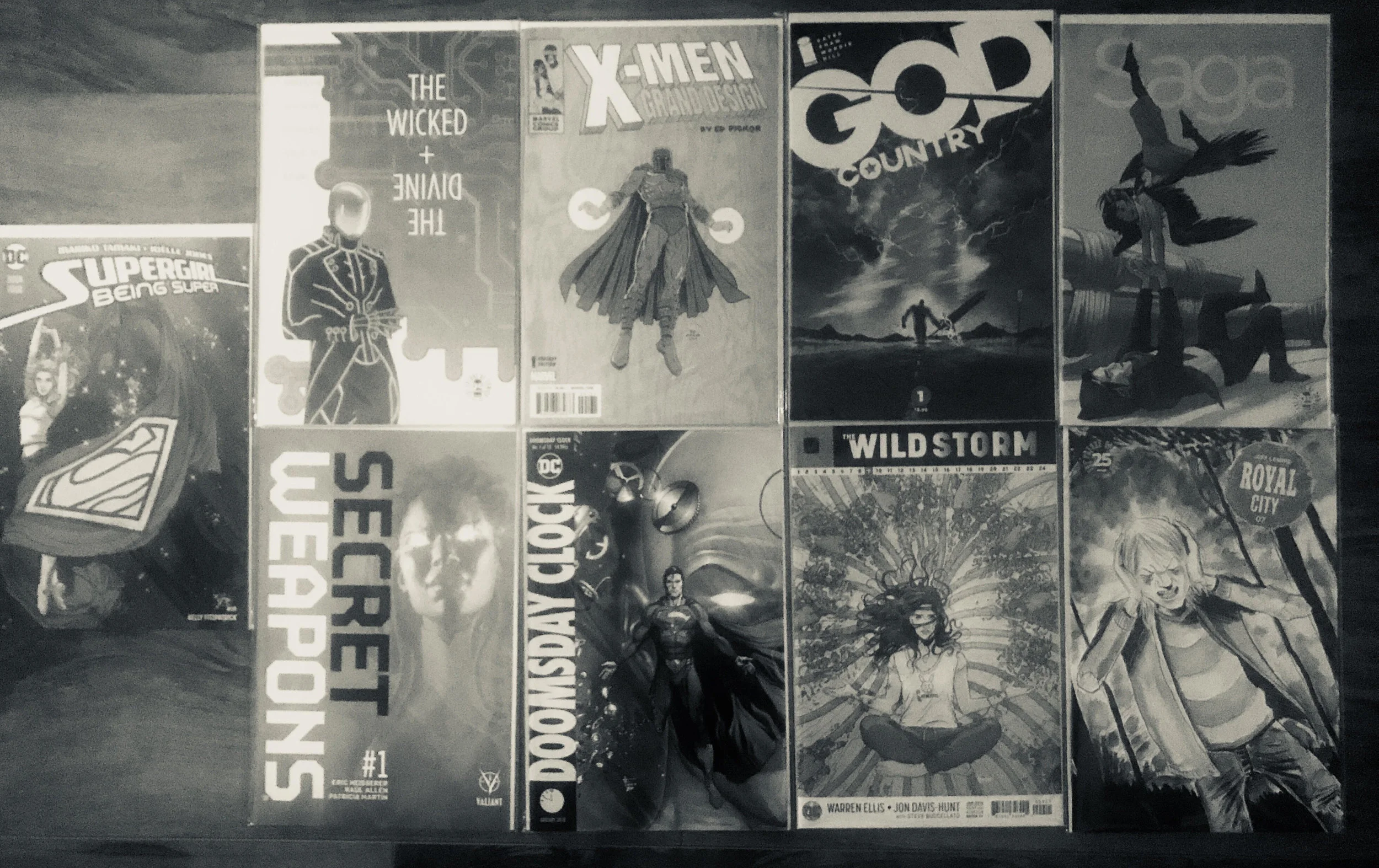
Picking the 5 best comics of the year was difficult, with God Country, Saga and Wic + Div all making aggressive arguments for why they should be included. I powered through, though, but the thing was, once I had a top 5, it was even harder deciding on an order. Changes were literally being made as recently as this morning. Making comics is tough, sure, but ranking comics is, well, slightly less tough but still pretty hard.

Anyway, this speaks to how good comics were in 2017, powered largely by a renaissance at DC. Whether this keeps going in 2018 is a matter of discussion best left to a future post, but as you’ll see here, 2017 really was a great year for DC Comics. The industry, however, also needs Marvel in order to comfortably sustain the thousands of small retail shops that sell books every Wednesday, but, again, that’s a matter of discussion best left for a future post.

Let’s get out of the future and into the past! That sounds good, right? I mean, if you spend as much time as I do reading about heroes created decades before you were born, the past is probably an interest of yours. But okay okay, no more rambling. Let’s do the thing.

The Top Comics of 2017

5. The Flintstones by Mark Russell / Steve Pugh
I remember openly laughing at this book when it was announced: a realistic monthly comic adaptation of The Flintstones. This was before Rebirth, when DC was still short on goodwill and almost every choice the publisher made was wrong. Man am I embarrassed by that laughing now. In time, it was my dopey pre-publication mockery that proved to be as thick as Barney Rubble.

With The Flintstones, writer Mark Russell and artist Steve Pugh created an incredible satire, one that used a prehistoric setting to examine so many issues that matter today, issues like religion, warfare, employer dominion over employees, gentrification, materialism, whether true happiness can be found in success, and the list goes on. Every issue was packed with more ethos and questions than a freshman philosophy course. It’s a shame that in June it had to end, but stop crying! Who's crying? I'm not crying, you're crying! Anyway, Mark Russell returns this month with a new book in the same vein, Exit Stage Left: The Snagglepuss Chronicles, which some critics are already calling the best new book of 2018.

4. Black Hammer (Sherlock Frankenstein and the Legion of Evil) by Jeff Lemire / Dean Ormston & David Rubin
Jeff Lemire’s work is difficult to describe. It's a special type of storytelling, so intriguing and layered that the entire scope of what drives it is rarely evident, even long after a story has ended (I still think about Plutona, like, often). Lemire is a nuanced writer who has supreme confidence in the worthiness of his stories, and nowhere is this more evident than in creator-owned books like Descender or Royal City.

What Lemire has done with Black Hammer, however, is even more impressive. He’s created a superhero universe unlike any we’ve ever seen. It has a similar mythos and many of the same tropes from those we know, but the world of Black Hammer is defined by a central tragedy in which the biggest superheroes inexplicably disappeared. It's a concept that would stem from a Big 2 event, before being quickly undone in order to return our heroes to the status quo. In Black Hammer, however, the heroes have never reappeared. Our story instead finds them aging and in a strange small town they can't escape. The tone is dour, the characters deep, the themes varied. Sometimes the story seems to be about family, sometimes contentment, sometimes duty, sometimes something I can't even guess.

The main storyline has paused for a moment while we digress into an auxiliary book, Sherlock Frankenstein and the Legion of Evil. This spot, however, is for the entire Black Hammer concept, which was one of the most original superhero takes of not just 2017, but of any year in recent memory. This might be a deconstruction of superhero deconstruction, but you'd have to ask Lemire to know for sure.

3. Batman by Tom King / Various
Tom King had such big shoes to fill when he took over this title. Scott Snyder and Greg Capullo had just stepped away after a 51-issue run during the New 52 era that ranks as one of the greatest in the history of the character, and, meanwhile, Scott Snyder was sticking around, playing the Jay Leno to King’s Conan by doing All-Star Batman while King was still working to find his way and his audience.

Unlike Leno and Conan’s dumpster fire of a situation, however, King’s and Snyder’s seems as if it has been mutually beneficial, pushing both writers to do some of the best work of their careers. While Snyder strings together one of the best events in recent memory with Dark Nights Metal, King has become a rock star at the height of his powers, putting out hit after hit after hit. He’s done multi-part arcs like The War of Jokes and Riddles, and he’s done stirring romance with issues like Batman Annual #2, which was the second best standalone issue of any comic this year, and Batman #37, the double date with Superman issue. Speaking of the best comic this year, that would be King’s Batman and Elmer Fudd special, an imaginative take on both of those characters that dove deep into their core conceits and emerged as a poignant and entertaining one-off.

I remember when Tom King was first announced as Scott Snyder’s successor on Batman at the DC Rebirth live stream launch event during Emerald City Comic Con. Someone (either Geoff Johns or Dan Didio or Jim Lee) asked Snyder how it felt to have King take over, and Snyder said you always kind of hope the next guy will be Hacky McScripty, but, ego aside, he was glad the character would be in good hands with King. At this point, I think all of comic fandom agrees (apologies, of course, to Hacky McScripty, a dirty sonofabitch who owes me money).

2. Mister Miracle by Tom King / Mitch Gerads
It’s nice that in a year of so much polarization and national discord, the entire comics industry and fandom could agree on Mister Miracle as one of the best books of the year. In fact, as I write this I’ve just come from Twitter where someone noted that Mister Miracle has been awarded best comic of 2017 more than any other book. Readers of the series understand why.

Mister Miracle has the makings of a modern masterpiece, just as King and Gerads’ Sheriff of Babylon was before it, just as King’s work on The Vision and Omega Men was before that. Like all of King’s best work, Mister Miracle turns its titular superhero into a lens through which we as readers are forced to view ourselves, evaluating our own reputations, skills, and struggles with malaise and depression. It’s a dour book that also has a sense of humor; it’s a bleak story with heart; it’s a tale of ugliness and suicide and betrayal that also brims with beautiful art.

It’s a study in contradictions, a story perfectly suited for our times, for the heavy examination we as Americans are doing in this chaotic era where norms are being broken and our country often can’t agree on even minor issues or concerns. Where facts themselves have been called into question. At the end of 2017, this book is just shy of halfway done, and based on what we've seen, I'm confident enough now to predict that its second half will make it one of the most praised books of 2018 as well.

Finally, I'd like to note that deciding between Mister Miracle and the final entry on the list was one of the most difficult things I’ve ever had to do as a critic.

1. Silver Surfer by Dan Slott / Mike Allred
Silver Surfer ranks as the best comic of 2017 and one of the best runs of all-time on any well-established superhero comic character. The final issue of Slott and Allred’s phenomenal collaboration ran in October, capping a story that started back in March of 2014 and saw the duo put out 29 phenomenal issues, some of which were innovative (the endless Silver Surfer #11 from the Marvel Now! era comes to mind) and all of which were filled (as I noted back in October) with Slott’s ambitious emotional concepts and Allred’s utterly unmatched eye for pop art.

Throughout its run, Silver Surfer was often delayed, but when it finally arrived it was immediately evident the extra time (which Slott says was his fault, always) had been put to good use. I’ve never read a book with such a unique feel. It was like watching a deep romance, an unfurling love story between The Surfer and Dawn Greenwood of Earth. The book was sweet and funny and sometimes even sexy. As I also noted in October, I’ll really miss it, and, to be honest, I can't intellectualize much more beyond that.

This Silver Surfer run accomplished one of the most difficult feats in modern superhero comics: it gave us an ongoing story that was driven by character but was at the same time satisfying on a monthly basis. It was this medium at its best: a mosaic of contained chapters that wove a larger tapestry but could also be appreciated for their individual merits. My favorite issue was the penultimate Silver Surfer #13, which was about our human desire to share our lives with a deeply beloved partner, all while knowing that time will eventually claim one of us, knowing how painful that day will be and deciding that loving another person is worth it anyway. It drove me to tears with its beauty.

Pt. 1, #16 - #25

Pt. 2, #6 - #15

January 01, 2018 /Zack Quaintance
Comics, Marvel Comics, DC Comics, Silver Surfer, Batman, Mister MIracle, Tom King, Dan Slott, Top Comics of 2017
Comics
unnamed-1.jpg

Top Comics of 2017, Pt. 2 #6 - #15

December 30, 2017 by Zack Quaintance in Comics

Long-running books like Saga and The Wicked + The Divine NOT cracking our top 5 comics of 2017 has absolutely nothing to do with the quality of those books. No, in fact, Saga is as good as always, while Wic + Div is reaching new and awesome heights, propelled by epic twists that have changed this story of music and gods as we know it.

Those books didn’t make the top 5 because, as you’ll see when part 3 drops (hopefully tomorrow!), 2017 was a killer year for comics, at least critically (sales is another story). In our top 5, we’ll have a truly phenomenal Marvel series with a perfect ending, and we’ll have one of the industry’s best writers doing great things on multiple books and characters over at DC. But hey, we’re getting ahead of ourselves! Let’s save it for the next post.

Besides, the crop we have here is pretty great. So, let’s quit fiddling around and check out 6 - 15!

15. Doomsday Clock by Geoff Johns / Gary Frank
We predict Doomsday Clock will end up higher on next year’s list once it's get further into the story, but at the moment we’ve only seen two of the twelve issues. Those issues, however, were quite promising, setting up a tale likely to have ramifications throughout the DC Universe. With Geoff Johns and Gary Franks leading the way, we’re in for some real good comic booking.

14. X-Men: Grand Design by Ed Piskor
As with Doomsday Clock, X-Men: Grand Design will likely be higher on next year’s list. We’ve only seen one of six issues, but this might just be a masterpiece. Reading this book is like watching a perfectly-executed historical documentary, one informed by massive amounts of research. Ed Piskor, the auteur behind Grand Design, did the same thing on his last book, Hip Hop Family Tree, which traced the history of that music genre as Grand Design traces the X-Men. Simply put, this is an unprecedented and artful attempt to streamline decades of convoluted stories, and Piskor is nailing it. If he’s willing, Marvel should have Piskor produce similar books about Spider-Man, The Avengers, Hulk, Iron Man and so on and so on, etc, forever.

13. Secret Weapons by Eric Heisserer / Raul Allen
There was a cinematic quality to Secret Weapons, a Harbinger offshoot that ended up being the best Valiant book this year. That cinematic feel is likely owed to writer Eric Heisserer, who also penned last year’s excellent film Arrival. Secret Weapons is about a team of underdogs who learn to use seemingly useless powers to combat a threat that is hunting them. The plot doesn’t break new ground, but the characters’ powers are fresh, the script is compelling, and the art is top-notch. I'm becoming exhausted with Valiant not letting series grow into themselves, but this mini was satisfyingly self-contained.

12. Deathstroke by Christopher Priest / Various
Deathstroke has been a highlight of DC Rebirth. It's written by PRIEST, an all-time great creator who returned to monthly comics to helm this, and man, are we lucky he did. The plotting and character work in Deathstroke is more complex and nuanced than almost any other superhero title today, and PRIEST is consistently planting seeds that payoff later. His work here has been so good that DC allegedly offered him the Batman editor gig (which he allegedly declined) before giving him its flagship team book, Justice League. Smart moves, all around.

11. The Wild Storm by Warren Ellis / Jon Davis-Hunt
We’ve gone two whole spots without saying this, but The Wild Storm is yet another book likely to be higher next year. There is an incredible amount of complex track being patiently laid here by writer Warren Ellis. In fact, before this book launched, Ellis said he’d plotted exactly what would happen and when (and which books would spin out of the title), and this intricate planning shows. Also, Jon Davis-Hunt is one of the most underrated artists in comics. His facial expressions are almost photographically realistic, and The Wild Storm #9 had a samurai sequence that ranks as the best graphic action storytelling of the year. We can’t wait to see where this goes.

10. Royal City by Jeff Lemire
Royal City is a personal and introspective book, easily the most personal and introspective book appearing monthly in almost every shop. What’s especially impressive for such an introspective book is that the story here is also relatable, rich as it is with family dynamics, economic struggles, addiction, etc., and it's told with a really cool ‘90s grunge vibe, super familiar to readers of a certain age. Also of note is that Royal City is written AND drawn by Jeff Lemire, whose Google Calendar must be INSANE because he’s writing a half dozen other books always.

9. Supergirl: Being Super by Mariko Tamaki / Joelle Jones
Supergirl: Being Super gives the titular character the reimagined out-of-continuity origin story treatment, a concept that has previously resulted in great stories about more prominent characters, mostly Superman and Batman, over and over and over. It's nice to see it now applied to Supergirl. All four of the glossy oversized issues that make up the run of this book were killer, and Joelle Jones’ art was so good it often felt like watching a great teen drama that was heavy on emotion. 

8. Saga by Brian K. Vaughan / Fiona Staples
Saga has been a favorite throughout its run, and we’ve given it to friends and co-workers who don’t read comics (harshly judging any who did not respond with praise), and we never miss an issue. Recently, @SageTerrence described this book on Twitter as “Star Wars and Romeo and Juliet combined,” which is a good starting point for explaining Saga. Taking it further, this is also a book about a family fighting to survive a galactic conflict that is so polarized and entrenched many of those engaged in it have lost sight of the cost, becoming blinded to what's productive and only focusing on whether they're right. This, sadly, was a tragically-relevant theme for 2017, a drag-ass year if ever there was one. Here’s to a better 2018, in which Saga continues to be this good.

7. God Country by Donny Cates / Geoff Shaw
Donny Cates was a talented up-and-comer when 2017 started. Then God Country dropped. Now, as 2017 ends, Donny Cates is a bonafide comics star. If you’ve read God Country, this makes total sense. The book was so good, my LCS now orders all of Cates stuff, marking the first time this particular shop has stocked AfterShock Comics or Vault Comics titles (because of Babyteeth and Reactor, respectively). Like all of Cates’ best work, this book is powered by a mix of unique concept and clever scripting, with a healthy coat of pure Texas, Cates native state.

6. The Wicked + The Divine by Kieron Gillen / Jamie McKelvie
It’s been easy to forget The Wicked + The Divine in recent years, not because the book hasn’t been good or memorable, but because it’s been so reliable. It’s like the friend you take for granted because he or she is always there. This year, however, Gillen and McKelvie took the story to new places with a blockbuster arc that paid off events from the first issue that pretty much anywhere realized would come back to be relevant. This year's incredible arc was easily Wic + Div’s best, no minor feat for a story that’s 30-some issues old. The end game is coming for this book, and while we're sad to see it end, we have total faith that the finale will be spectacular. 

SPECIAL NOTE: The exciting conclusion, complete with the Top 5 Comics of 2017, is coming tomorrow!

Pt. 1, #16 - #25

December 30, 2017 /Zack Quaintance
Comics, Comic Books, Marvel Comics, DC Comics, Image Comics, X-Men, Doomsday Clock, Watchmen, Valiant Comics, Wild Storm, Deathstroke, Geoff Johns, Warren Ellis, Royal City, Jeff Lemire, Saga, Brian K. Vaughan, Supergirl
Comics
Top Comics of 2017

Top Comics of 2017, Pt. 1: #16 - #25

December 29, 2017 by Zack Quaintance in Comics

Nearly a year ago to the day, Civil War II #8 came out with a pitiful whimper, eliciting mostly shrugs from fans and lackluster reviews online. At the time, Marvel must have thought, well, it’s a new year soon, we can regroup, and things can only get better from here.

Without going into detail about Marvel’s troubles, things did not get better. Things, in fact, got worse—much worse. So epicly worse that earlier today the Hollywood Reporter published a piece about how almost everything that could go wrong for Marvel in 2017 went for Marvel in 2017, like the House of Ideas was suddenly Jurassic Park, battling Ian Malcolm’s Chaos Theory.  

And my Top Comics of 2017 reflects this. A scant 3 of 25 spots on the list went to Marvel. By comparison, 10 went to DC and its various imprints, and 11 went to independent publishers, with Image unsurprisingly leading the way with 6 books. But this list is supposed to be celebrating the good! So, enough about problems. I’m sure much will continue to be Tweeted and blogged about Marvel’s ongoing struggles anyway. 

So, let’s get to the obsession that, if you’re anything like me, drives you to some storefront every Wednesday for a stack of floppy comics, a medium that blends of art and capitalism better and more directly than anything else this great nation of ours has conceived.

Here are 16 - 25 of the my top comics of 2017. Enjoy!

25. Infamous Iron Man by Brian Michael Bendis / Alex Maleev
I’ve said this on Twitter and been met with silence from my admittedly modest following, but one of the most interesting things about Brian Michael Bendis ending a nearly two-decade run at Marvel is that in 2017 Bendis quietly did great work for the publisher. Jessica Jones, Defenders, Spider-Man and Invincible Iron Man were all engaging, character-driven stories. Spider-Men II didn’t work for me, but the rest were A+, and none was better than Infamous Iron Man, 12 excellent issues that tackled ideas of public redemption and also featured Doctor Doom cleaning house.

24. Catalyst Prime by Lion Forge
I’ve dug Lion Forge’s Catalyst Prime books, an ambitious attempt at a new superhero universe. It doesn’t have iconic characters like Marvel or DC, obviously, and because of this, at times the stories can be fuzzy and dull. That’s just the cost of doing business in a world where there are really only 8 - 10 good superhero narratives. What Catalyst Prime does at its best is provide alternative takes on these narratives, positing questions like what if an alienated teen hero had a disability, or what if a suave rich guy hero got an unglamorous power rooted in mindscapes and introspection? Within this line, I like Superb and Astonisher the best, with Noble close behind. The art in Accell is strong and Summit is promising after only one issue.

23. Clean Room by Gail Simone / Jon Davis-Hunt & Walter Geovani
This book was so good for its entire run, but it seemed like nobody paid attention. I get that Vertigo had fallen on hard times, but Gail Simone is one of the best writers in the industry and Jon Davis-Hunt’s art is Frank Quitely-esque yet still wholly his own (Walter Geovani also did an admirable job when Davis-Hunt left for The Wild Storm). Anyway, since I feel like the only one who read this, I want to implore you now to please please please pick this up in trade, so we can get another volume of Clean Room at some point.

22. Grass Kings by Matt Kindt / Tyler Jenkins
Grass Kings is a beautiful and deliberate book, rich with Matt Kindt’s interest in the effects of malfeasance or neglect through time and Tyler Jenkins blurred, almost abstract watercolor artwork. It’s a book that feels real, from the things the characters do and say to the ideas about independence and transparency and the cost of preserving a larger community even if it means sacrificing safety of those inside. At least, that’s how I’ve read it so far anyway. This is a bit of a mystery book, the scope of which is yet to be made entirely clear.

21. Snotgirl by Bryan Lee O’Malley / Leslie Hung
There are few books as stylish or obsessively in the moment as Snotgirl, a tale of a vapid Instagram model in LA, who is only concerned with personal growth if that growth leads to a reduction in the severity of her super gross allergies. This book is a smart take on us as a social media generation, as well as a meditation on the personality disorders constant social media validation is likely creating.

20. Victor LaValle’s Destroyer by Victor LaValle / Dietrich Smith
Victor LaValle is one of my favorite literary writers, and, in fact, I may write a post early next year about how his novel The Changeling is a good choice for fans of modern suspense and horror comics. But that’s later. If you’ve already read the Changeling, I can tell you Destroyer’s plot has far more action and sci-fi, but it also has the themes of parenthood, being the other and technology that powered The Changeling, glossed with a layer of mythology culled from Mary Shelley’s Frankenstein. Trust me, it works.

19. Super Sons by Peter Tomasi / Jorge Jimenez
Super Sons did an impressive job telling a story about new characters and a new situation (Batman and Superman mutually raising adolescent sons) while also creating a nostalgic, classic feel that so many fans enjoy, myself included. This book was filled with fresh stories that felt familiar, and although we’re only 11 issues in, the scripts by the criminally underrated Peter Tomasi made this book feel as if it had been around for years. I love all things Super Sons, and I hope this rumor about Brian Bendis taking over Superman doesn’t rock the boat (Bendis never seems to write just one book about a character, see Iron Man, see X-Men). And Jorge Jimenez's impossibly clean lines are a perfect fit.

18. Aquaman by Dan Abnett / Various
Dan Abnett’s Aquaman has been a great book since before DC Rebirth, depicting Arthur Curry as a global diplomat constantly juggling a desire to do the right thing for Earth, to placate the nationalistic populism of his people in Atlantis, and to soothe the fears and concerns of the equally nationalistic populist surface dwellers. This book, however, has really become something special now that *SPOILER* Abnett has taken Arthur off the throne and put him in Atlantis’ underworld, where he leads a timely resistance effort against the leader that schemed to replace him. Oh, and Stjepan Sejic dual work as artist and colorist since June has been something to behold. His aesthetic is a fantastic fit for the character.

17. Think Tank by Matt Hawkins / Rahsan Ekedal
Think Tank, now on its fifth volume since launching in 2012, was as sharp as ever, taking writer Matt Hawkins dense scientific research and insatiable curiosity about the military, and distilling it into stories about global dynamics, all while telling the personal story of Dr. David Loren. What I like so much about Think Tank is every arc essentially tells three stories at once: one about the protagonist’s personal life, one about technology, and one about global affairs. It never becomes unwieldy, which is a testament to Hawkins’ deft plotting and Rahsan Ekedal’s crisp art.

16. Extremity by Daniel Warren Johnson
Aside from the gorgeous artwork, strong family dynamics and earned big twists, one of the things that endeared Extremity to me was artist / writer Daniel Warren Johnson’s earnest back matter, in which he explained this story is about his greatest fear: losing his drawing hand. It’s a personal premise, and Johnson does a great job of weaving a rich sci-fi / fantasy around it.

SPECIAL NOTE: Tomorrow I'll be posting my Top Comics of 2017, Pt. 2: #6 - #15, and Sunday I'll be posting my Pt. 3: #1 - #5.

December 29, 2017 /Zack Quaintance
Iron Man, Marvel Comics, DC Comics, Brian Michael Bendis, Lion Forge, Catalyst Prime, Best of 2017, Top Comics 2017, Grass Kings, Superman, Batman, Super Sons, Snotgirl, Victor LaValle, Aquaman, Image Comics, Think Tank
Comics
  • Newer
  • Older