|
Plus, the comic of the month, do publisher kickstarters hurt the little guy, a pair of 2025 movie recs, and more ͏ ͏ ͏ ͏ ͏ ͏ ͏ ͏ ͏ ͏ ͏ ͏ ͏ ͏ ͏ ͏ ͏ ͏ ͏ ͏ ͏ ͏ ͏ ͏ ͏ ͏ ͏ ͏ ͏ ͏ ͏ ͏ ͏ ͏ ͏ ͏ ͏ ͏ ͏ ͏ ͏ ͏ ͏ ͏ ͏ ͏ ͏ ͏ ͏ ͏ ͏ ͏ ͏ ͏ ͏ ͏ ͏ ͏ ͏ ͏ ͏ ͏ ͏ ͏ ͏ ͏ ͏ ͏ ͏ ͏ ͏ ͏ ͏ ͏ ͏ ͏ ͏ ͏ ͏ ͏ ͏ ͏ ͏ ͏ ͏ ͏ ͏ ͏ ͏ ͏ ͏ ͏ ͏ ͏ ͏ ͏ ͏ ͏ ͏ ͏ ͏ ͏ ͏ ͏ ͏ ͏ ͏ ͏ ͏ ͏ ͏ ͏ ͏ ͏ ͏ ͏ ͏ ͏ ͏ ͏ ͏ ͏ ͏ ͏ ͏ ͏ ͏ ͏ ͏ ͏ ͏ ͏ ͏ ͏ ͏ ͏ ͏ ͏ ͏ ͏ ͏ ͏ ͏ ͏ ͏ ͏ ͏ ͏ ͏ ͏ ͏ ͏ ͏ ͏ ͏ ͏ ͏ ͏ ͏ ͏ ͏ ͏ ͏ ͏ ͏ ͏ ͏ ͏ ͏ ͏ ͏ ͏ ͏ ͏ ͏ ͏ ͏ ͏ ͏ ͏ ͏ ͏ ͏ ͏ ͏ ͏ ͏ ͏ ͏ ͏ ͏ ͏ ͏ ͏ ͏ ͏ ͏ ͏ ͏ ͏ ͏ ͏ ͏ ͏ ͏ ͏ ͏ ͏ ͏ ͏ ͏ ͏ ͏ ͏ ͏ ͏ ͏ ͏ ͏ ͏ ͏ ͏ ͏ ͏ ͏ ͏ ͏ ͏ ͏ ͏ ͏ ͏ ͏ ͏ ͏ ͏ ͏ ͏ ͏ ͏ ͏ ͏ ͏ ͏ ͏ ͏ ͏ ͏ ͏ ͏ ͏ ͏ ͏ ͏ ͏
The Thought Bubble ‘25 Recap, and more!
|
|
Hey everyone! Many of you are getting this newsletter for the first time because you asked to be added on your backer survey for Macabre Valley, and I’m so grateful you did. This newsletter is the best way to keep up with new Comics Bookcase projects, as well as my thoughts about comics, the industry, other media, and more in between. If you’re only aware of me as a comic book writer, I’m also the reviews editor for the Eisner-winning website, The Beat, and in this space I often discuss my work there, trying my best to be timely, interesting, and relevant, of course. This monthly newsletter is broken into five parts, four of which are as follows: -comic of the month -insight into my comics journalism -thoughts about a broader industry issue -a recommendation for non-comics media. The fifth segment—my favorite—is a brand-new artist commission, generally of one of the characters from my comics, ranging from the werewolf priest to the Comics Bookcase (the Crypt Keeper for my Death of Comics Bookcase series). That’s the general structure. I also do Best Of newsletters a few times a year, ranking my favorite or most-anticipated comics. I hope you stick around. We’ll get into is sections shortly, but first I wanted to do a quick recap of my trip to Thought Bubble 2025, an absolutely wonderful show held in the U.K., where I brought Macabre Valley #1 to be debuted at Anna Readman’s table.
|
|
If you are here via the Kickstarter, you are likely aware of Anna’s work. Anna is one of the most exciting young artists in comics, and she’s done award-winning independent work as well as stories for the U.K.’s biggest comics publisher, 2000 AD. You can learn more through her Instagram and/or her website. I was absolutely thrilled to collaborate with her on Macabre Valley. We’d met virtually years ago, after she did a cover for my first comic, Next Door. That cover got a bigger response than the book itself, and I’d followed her work ever since. After I wrote the first eight pages of MV, I went lookin on Instagram for an artist…and that very same day, Anna posted about being available for work because she’d had some projects fall through. It felt serendipitous, so I reached out. And she enjoyed the script enough to work on it. We conceptualized a pitch to publishers, and while I had conversations about it with a couple editors, neither followed up. In comics, ghosting is the standard rejection. But I was so thrilled with how our pitch read, that I kept thinking about a full first issue, and I kept in touch about it with Anna. Finally, her schedule cleared, and she was able to draw the rest of the issue earlier this year. That’s all to say that it was a long road to get Macabre Valley #1 to Thought Bubble, and as such, being at the show with the book felt like no small triumph. Thought Bubble is two days, and I had an absolute blast throughout telling folks to head to Anna’s table to check it out. It’s always nice having something new and exciting to discuss with creators I deeply respect, but on top of that, it was just so nice to meet Anna in person, especially after having worked with her for so long primarily via email. Here we are in the closing hours of the show…
|
|
And Thought Bubble itself is fantastic. It’s almost hard to describe, because it’s so different from the shows we have in the U.S. You won’t find long lines to meet former Saved By The Bell cast members or whatever, and rather than being held in some giant airconditioned convention center the week after some other conference, Thought Bubble is spread across a series of smallish halls in a charming British spa town. You walk outside after the show and you cleansing see things like THIS.
|
|
This is an over simplification, but I think the closest comparison we have here is if Heroes Con and Small Press Expo met somewhere between…plus a few dozen fantastic European artists who don’t ever make it to the States. Which is to say you get mainstream comics artists, underground/more literary comics artists, and a crowd that clearly enjoys to read. It was also wonderful getting to see so many members of the comics press who I’ve known for a good while, including Dean Simons and Jared Bird (both of whom I know from The Beat), Sean Dillon (who I’ve edited now across multiple websites), and the great Steve Morris, who now does comics press AND works in marketing for 2000AD. And it was also fantastic chatting with too many great creators to name while at the show. Ahead of the show, my wife and I also spent a couple days in London enjoying the city, which is currently in full-on Christmas mode, and afterward, we stopped in York and Leeds. All told, we were in the UK for just over a week, and it was wonderful. I think we’d probably live there if given the chance, but we say that about most places we vacation. I’d love to go back to Thought Bubble again, and I’m sure I will. It likely won’t be possible to go every year, but, hey, every other year doesn’t seem too difficult, especially given that flights from JFK to Heathrow are somewhat reasonable. I’ll close this little recap/intro here by saying, if you yourself have an inkling to attend Thought Bubble…do it. You’ll be thrilled you did.
|
No.1: Art by Dave AcostaThis month’s newsletter commission comes to us from Dave Acosta (Instagram; website). Dave — whose work you might know from books like TerrorWar, the Elvira comics, and/or our pal Rylend Grant’s recent Evel Knievel Kickstarter — actually did this piece almost a full year ago. But as you maybe noticed, it’s been all werewolf priests around here for a while to support the Macabre Valley campaign, so I haven’t had a chance to share Dave’s take on the ape wraith from Apes V. Sharks…until now. A fun note on this one is that Dave is pals with artist Ryan Lee, who drew the Comics Bookcase interstitial pages in Death of Comics Bookcase, Vol. 1, and is currently working on the framing sequence for Death of Comics Bookcase, Vol. 2: Reign of the Comics Bookcases. If you backed Macabre Valley #1, you saw a page of Ryan Lee art in the back, teasing Vol. 2. But despite that friendship, Dave wasn’t interested in drawing the Comics Bookcase. No, the allure of drawing a truly excellent comics ape was too strong, and that’s what Dave delivered…
|
|
Apes and comics are one of those creative things that just work. If you’re new to my comics from the Macabre Valley #1 campaign, my previous book, Death of Comics Bookcase, Vol. 1 (2024), saw PJ Holden and I collaborating on a seven-page story entitled Apes V. Sharks: The Omega Brain IV, a war comic with a good bit of metafictional nonsense on top. And that’s where the above character comes from. That segment left off on a bit of a cliffhanger, and if everything comes together right in the next few months (my writing of a follow-up along with PJ’s schedule, specifically), odds are favorable that there will be more apes AND more sharks in Death of Comics Bookcase, Vol. 2. Stay tuned to this space for updates on that! And if you are hoping that a new artist will draw the monstrous Comics Bookcase character that Ryan and I co-created, we’ve got something very exciting in the works for next month, maybe even a something sporting a seasonally-appropriate Santa Hat…
|
No. 2: Comic of the Month - Sleep by Zander CannonI read a lot of single issue comics in order to put together my weekly Top Comics to Buy column for The Beat. It’s not an exaggeration to say I read between 18 - 25 single issue comics every week. This can sometimes mean that very good comics fail to grab me with just their first issue, even if that first issue is good. By comic 15 or so any given week, I start feeling a bit loopy. This was the case for the new comic from writer/artist Zander Cannon. I read Sleep #1, and the series kind of got lost amid whatever else was out that week. But on the plane to Thought Bubble, I binged all six of the currently available issues (Sleep #7 is due out on Christmas Eve), and I absolutely loved this book, to the point it may end up on my Best Comics of 2025 list. Sleep is a smartly-constructed comic. The core concept is that a vague-but-murderous event is happening every night in a small town. We as readers are given a close third person perspective to the protagonist, and we know only what he knows. From there, we see our character go to sleep—and next we see him waking up, confused and in the aftermath of a night of bedlam, usually bloody. This enables Sleep to drive its narrative forward with a mystery. Is our character the one committing the atrocities? How is he committing the atrocities? What exactly is causing this and why? The atrocities also become increasingly severe, evolving from murdered livestock to a broad threat to every person in the entire town. And around the periphery there are other intriguing elements too, my favorite being the vagrant who may or may not be the only one who understands the nature of what’s happening. Binging Sleep #1 - #6 was the best bulk comics reading experience I’ve had in some time, and it left me dying to finish the story right now. If you like me missed this book when it started, I highly recommend playing catch up. There’s even a community of theorists who’ve sprung up and are featured in the back matter. Sleep is just a very well done horror/mystery comic, told in a way that makes it excellent to follow month-to-month.
|
No. 3: The state of DC Black LabelWhile my primary focus is now on writing comics, I’m still a volunteer/occasionally-paid comics journalist in my spare time as well, contributing to the Eisner-winning website, The Beat, where I am the reviews editor. I’ve been writing for The Beat since 2018, when I signed on to help Heidi MacDonald and co. cover San Diego Comic Con and never left. While my exact contributions to The Beat have shifted over the years, the one consistency has been the site’s weekly DC Round-Up column. What that entails is reading 90 percent of DC’s releases (the publisher gives us review access digitally via a specialized Box drive), and then once a month writing a roughly ~1000 word column about a big book, along with a rapid round-up of blurbs about other books. It’s fun to follow a publisher’s output like this long-term, as well as share my lifelong perspective on silly superhero comics with other lifelong comics sickos. What it also means is that at major shows like San Diego Comic Con and New York Comic Con, I am the person in the room for the site, writing news in real time as DC Comics rolls out its shiny new initiatives. I’ve seen DC editors unveil everything from the short-lived horror imprint headed by author Joe Hill to last month’s Vertigo Comics return/revitalization. I’ve seen hype and I’ve seen how it all evolves over time. Recently, I’ve been reflecting on what this has meant for DC’s Black Label imprint, which to me began life as a rather poorly-defined idea from prior leadership, before evolving into it’s current role as a space to tell sophisticated stories with the company’s iconic superheroes. It is, essentially, the companion piece to Vertigo, in that Vertigo is for original stories for folks who enjoy the finer things, while Black Label does smart work with existing superheroes. The state of DC Black Label is strong and getting stronger. While it’s not the most prolific imprint in comics, it doesn’t need to be, as it’s delivered a string of well-done, boundary pushing superhero books, including Superman: The Kryptonite Spectrum, Resurrection Man: Quantum Karman, Plastic Man No More, and The Boy Wonder. And it has set loose some of the most interesting creators on the DCU, from W. Maxwell Prince to Juni Ba to Ram V., and more. This month gave me a chance to write about the newest Black Label series, Batman/Green Arrow/The Question: Arcadia, by writer/artist Gabriel Hardman, colorist Romulo Fajardo, Jr., and letterer Simon Bowland. You can read my full review from the DC Round-Up here, but the TL:DR of it is that I was impressed. Superhero comics that say things about real world global affairs often get bogged down by their own loftiness, but this one does it well, with what feels like a really smart update on the planet these characters inhabit. At the center of the book is an idea that the biggest global problems ultimately cause troubles for real people at the community level. Plus, stealth suit Batman flies over the jungle dangling from a drone. Comics. If you’re an adult who (like me) insists on continuing to read these comics, books like this are the reason why, and I’m glad they exist.
|
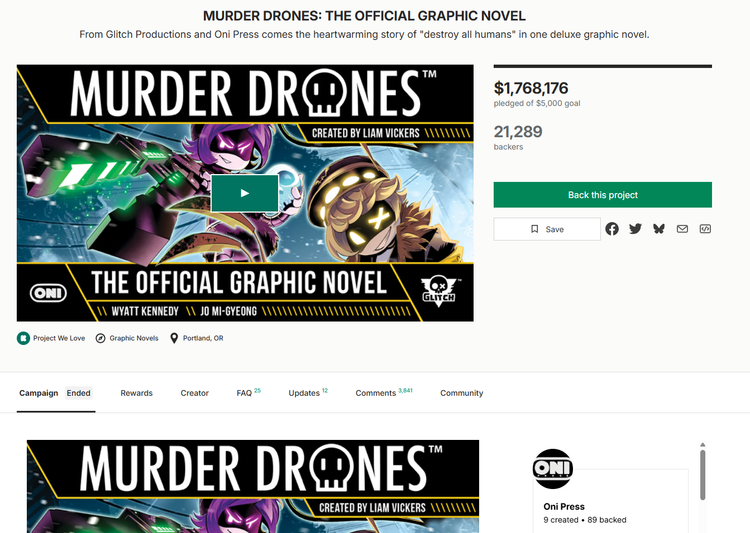
Thing 4: Do publishers using Kickstarter hurt the little guys?Now that I have three (modestly) successful Kickstarter campaigns to my name, a lot of folks like to ask me for my thoughts about Kickstarter. The question I get asked most is — often with a lowered voice and sideways glance, as if about to discuss something inflammatory — how do I feel about comics publishers using Kickstarter for their campaigns? And I’m happy to answer — I actually think it’s 80 percent helpful to fully independent comic book creators like myself. One of the biggest barriers you face as a Kickstarter comics creator is getting new would-be backers onto the platform and normalizing it as a way to purchase and read comics. The challenges in doing so are two-fold. First, there’s a basic logistic challenge. If someone does not have a Kickstarter account, they cannot back a Kickstarter campaign. They might see your artwork or elevator pitch on one of the half dozen social media networks we use now to market our work. They might even click through. But without an account, the chance of them actually backing your book drops. Consider: how many times have you personally been intrigued by a social media ad, only to lose interest partway due to a laborious registration/purchase process? It happens…a lot. Second, I think any time a comics reader has a positive experience with a Kickstarter, it’s a good thing for other Kickstarter creators. A rising tide lifts all boats, etc. In my opinion, what hurts independent Kickstarter creators far more than Oni Press, Skybound, or BOOM! campaigns, are campaigns with little regard for quality control. The realities of Kickstarter are such that we can’t compete price-wise with Big 2 comics published in bulk by giant corporations who will cost cut and exploit artists to maintain market share. We never will be able to charge prices anywhere close to them. What we’re selling, however, is a bespoke experience. When you back a Kickstarter, you get to be one of only a few hundred people (maybe) to get a copy of a book. And you get the increasingly rare feeling of directly supporting a truly independent human artist. As corporations continue to embrace impersonal technologies and business practices, backing real independent people becomes an increasingly satisfying act of defiance, and crowdfunding campaigns run by individuals are a pure way to go What undercuts that, however, is when we as creators don’t honor that support by doing the best we can to offer a great experience. What hurts the community is when a campaign takes too long to fulfill with little to no explanation, or when it sends out damaged rewards, or when a book just isn’t very good. I say all this as someone who has backed more than 400 projects and plans to back a few dozen more next year. I really enjoy putting my money toward independent comics, even if there is some risk there. Still, I think when Skybound runs a campaign that backers love, it has the potential to help us indie creators. I’m clear-eyed about this, too. I know the vast majority of G.I. Joe Kickstarter backers won’t even look at a book they haven’t heard of. But the margins for indie crowdfunding campaigns are so slim, that every backer counts. So if a fraction of G.I. Joe backers have a good time and go on to embrace the platform, that’s great for me. Why then did I say it’s only 80 percent good for me that publishers are now always running Kickstarters? Because I do think there is a limit to how many campaigns most backers can/will support in a given month, and once they hit that, they’re done. So the bigger pricier campaigns do have the chance to cost you backers if you launch alongside too many of them at once. But on balance, I’m supportive of any well-done campaign that brings in new users and gives them a satisfying experience.
|
No. 5: One director, two 2025 classicsIt’s tempting to just say One Battle After Another, the new Paul Thomas Anderson film, is the best movie of 2025 and be done with any discussion of this year. And I thought that film was a timely masterpiece, as well as an absolute blast to see in a theater (in any of the like six different formats it was released in). But there’s another director who I think has to at least be discussed as part of the Best Movies of 2025, and that’s the great (and underrated tbh) Richard Linklater, who released not one by two fantastic films in 2025. And while they may not be the talky booming showpiece that One Battle is, they are both total stunners late into an incredibly satisfying and impressive directorial career. Have you seen Breathless? The black-and-white 1960 French New wave film directed by Jean-Luc Godard? You ought to, in part because it makes essentially every list of must-watch films for cinephiles, due to how influential and groundbreaking it was and still is, but also in part because Linklater’s new movie Nouvelle Vague is a fictional imagining of what went into making that movie, and it’s a blast. Nouvelle Vague is quirky, funny, and deeply concerned with the circumstances around making lasting, innovative art. And while I generally do appreciate movies about making movies, there is often a serious undercurrent around frustration, sacrifice, and suffering inherent to a lot of those films, which, frankly, can feel a bit self-important and overly-serious. Nouvelle Vague has none of that. It’s concerned with the same things, but it comes from a place of triumph and eccentricity, and it feels as if it’s built upon ideas of how remarkable filmmaking can be, rather than how much it can exact from its actors and filmmakers. It’s also absurdly quotable, to the point that when it rolled credits, I had decided I would soon rewatch Breathless, and when I was done I would immediately also rewatch Nouvelle Vague. A movie like this would be a good year for any filmmaker especially one who is approaching 20 total features like Linklater, but it’s also a movie that has the potential to be somewhat insular. Creatives and cinephiles would call it one of their favorites of the year, and, meanwhile, it would have little awareness among the general public. Well, Linklater also has another film out this year that feels like it might reach those folks (or at least a few of them), and that film is Blue Moon. Starring frequent Linklater collaborator/analog Ethan Hawke alongside Margaret Qualley (who my wife and I waited behind at concessions before an off Broadway play earlier this month, but that’s another story and let’s be real a bit gauche to share…), Blue Moon is also a meditation on being creative and living the art life. Inspired by the letters of Broadway songwriter Lorenz Hart, at first blush it seems as esoteric as Nouvelle Vague, albeit with the key differences of being in color, having recognizable movie stars, and not having subtitles over (mostly) French dialogue, like Nouvelle Vague. What I think makes this film more likely to break through to mainstream viewers is the heavy likelihood it receives Academy Award consideration, sending catch-up viewers flocking to it before filling out sheets for their Oscar pools. And while One Battle After Another feels poised to absolutely dominate at the Academy Awards this year, I think Blue Moon will find a good number of appreciators as well. Both of these movies, though, are just such a reminder that Linklater is one of the great working American filmmakers of all time, and how capable he is of varied, thoughtful, and deeply funny work that also has powerful questions and emotional cores beneath it. Check them both out, they’d make for a great double feature when taken together, and a good way to end a creative year. Conclusion That’s it for this month. For those of you who joined after the Macabre Valley #1 campaign, I just wanted to say again how grateful I am you all are here, and how I hope you enjoyed the book enough to want to stay. This newsletter gives you a pretty good idea of what to expect each month. In December, however, I’ll run down my personal favorite comics of 2025, after sharing that month’s artist commission of course. I hope you’ll be back again to join us. Cheers, be well, and please forgive any and all typos above! -Zack Q.
|
|
|
|