|
Plus, a new commission by Tony McMillen, a cult comedy from the ‘90s gets an uncensored cut, and more! ͏ ͏ ͏ ͏ ͏ ͏ ͏ ͏ ͏ ͏ ͏ ͏ ͏ ͏ ͏ ͏ ͏ ͏ ͏ ͏ ͏ ͏ ͏ ͏ ͏ ͏ ͏ ͏ ͏ ͏ ͏ ͏ ͏ ͏ ͏ ͏ ͏ ͏ ͏ ͏ ͏ ͏ ͏ ͏ ͏ ͏ ͏ ͏ ͏ ͏ ͏ ͏ ͏ ͏ ͏ ͏ ͏ ͏ ͏ ͏ ͏ ͏ ͏ ͏ ͏ ͏ ͏ ͏ ͏ ͏ ͏ ͏ ͏ ͏ ͏ ͏ ͏ ͏ ͏ ͏ ͏ ͏ ͏ ͏ ͏ ͏ ͏ ͏ ͏ ͏ ͏ ͏ ͏ ͏ ͏ ͏ ͏ ͏ ͏ ͏ ͏ ͏ ͏ ͏ ͏ ͏ ͏ ͏ ͏ ͏ ͏ ͏ ͏ ͏ ͏ ͏ ͏ ͏ ͏ ͏ ͏ ͏ ͏ ͏ ͏ ͏ ͏ ͏ ͏ ͏ ͏ ͏ ͏ ͏ ͏ ͏ ͏ ͏ ͏ ͏ ͏ ͏ ͏ ͏ ͏ ͏ ͏ ͏ ͏ ͏ ͏ ͏ ͏ ͏ ͏ ͏ ͏ ͏ ͏ ͏ ͏ ͏ ͏ ͏ ͏ ͏ ͏ ͏ ͏ ͏ ͏ ͏ ͏ ͏ ͏ ͏ ͏ ͏ ͏ ͏ ͏ ͏ ͏ ͏ ͏ ͏ ͏ ͏ ͏ ͏ ͏ ͏ ͏ ͏ ͏ ͏ ͏ ͏ ͏ ͏ ͏ ͏ ͏ ͏ ͏ ͏ ͏ ͏ ͏ ͏ ͏ ͏ ͏ ͏ ͏ ͏ ͏ ͏ ͏ ͏ ͏ ͏ ͏ ͏ ͏ ͏ ͏ ͏ ͏ ͏ ͏ ͏ ͏ ͏ ͏ ͏ ͏ ͏ ͏ ͏ ͏ ͏ ͏ ͏ ͏ ͏ ͏ ͏ ͏ ͏ ͏ ͏ ͏ ͏ ͏
The State of Comic Book Conventions
|
|
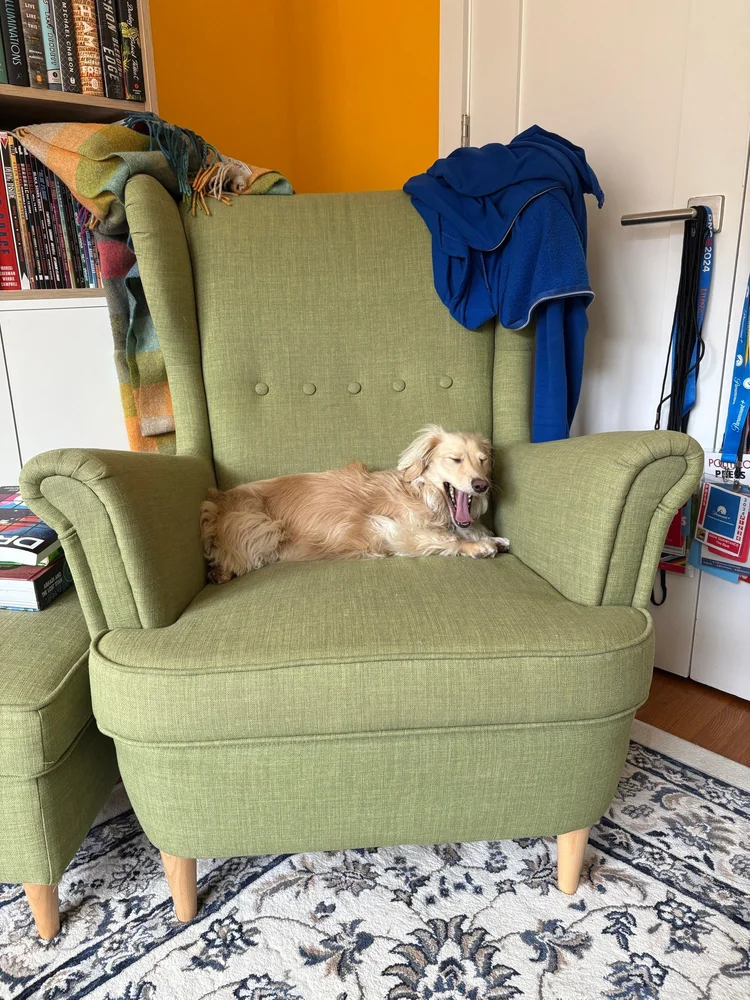
Hey everyone! I’m writing to you now from beneath a sheen of near-total exhaustion (see dog-assisted visualization below). Basically, as soon as we’d finished unpacking our boxes following our move to NYC, I found myself facing down three consecutive weekends of out-of-town trips. And two of those trips were for comic book conventions. Well, technically the second trip was for this year’s American Library Association Conference, but as I’ll get to shortly, that event has become increasingly important to comic book publishers, established comic book creators, and maybe even people like myself who are hoping to get in good with the first group … and ultimately become part of the second group.
|
|
I enjoyed those trips, saw some friends, met some new people, and came away with some insights. So, that’s what I’m primarily writing about this month: the experience of going to a traditional comic book convention one week, followed by a library conference full of comics the next. It got me thinking about the overall State of Comic Book Conventions, wondering, do these still work for comic book readers? Do they work for creators? What does a guy have to do to get a table that’s NOT between the concession stand and the bathroom? And is there a better way for the industry writ large to do its events? I have tried my absolute best to answer — or at least contemplate in a semi-engaging way — all those questions below. But first! Everyone’s favorite thing…
|
Thing 1: The artThis month’s commission is by the great Tony McMillen (Bsky; Instagram; Patreon), and it features the ever-popular werewolf priest character from the short story in Death of Comics Bookcase, which is currently being expanded into a full series, called Macabre Valley (technically unannounced, so keep that under your hat…). It’s awesome to me that a such a simple, silly concept — werewolf priest — sparks something in so many great comics artist, starting with John McCrea, who did the main cover for Death. And now we got a werewolf priest commission from Tony, who picked the character out of everything in the book. Here’s Tony’s take…
|
|
Phew. So damn good. The first thing that jumps out to me with this piece is the blue-red color scheme, which is both sensational and ominous. I also really love Tony’s take on the werewolf snout (less angular), and, of course, the prominent, almost-casual way he’s holding his claws. Just a great piece. I’m working on turning this one and a couple of others that have appeared in this space into post cards for future Kickstarter campaigns. I know I’d like one of these taped up around my own desk. Meanwhile, as far as Macabre Valley…it’s still coming along. I saw the colorist on the book, Brad Simpson, at Heroes Con, and he was exited to get at some of Anna Readman’s new, inked art. Again, one of the luxuries of indie comics is you have total power of your deadlines. Although, a little voice does creep into your head, telling you you need to make your books faster to keep folks interested. I’m trying to ignore that and make everyone has the time they need to do their best work. Once the book comes together, it’s easy to see that voice was absurd. Anyway, will keep you all posted as that book continues to come together.
|
Thing 2: Heroes ConNow, onward to what we’ve really come to talk about — comic conventions, starting with my favorite show (period) in the U.S., Heroes Con. Heroes Con is a three-day show in Charlotte, N.C., and normally I think three-day shows are a bit much, but this one not so. I only went to two days this year because of my move, and was pretty bummed to miss out on Sunday. And I never feel that way about other shows. So what makes Heroes so great? There’s a few things, which I’ve listed in brief below… Indie Island/Artist Alley: Heroes has the best artist alley in comics, at least as far as U.S. shows go. It doesn’t have the star power of something like NYCC, but it’s got more pure indie artists. Your chances of discovering something new are much higher. Also, the stars that are there are there in a much more relaxed setting. You can talk to folks at NYCC, but often times, there’s a line at the table, or someone else sidles up behind you instantly, cutting conversations short. Heroes is a more relaxed show where you can really catch up with people or get to know them, in those fun 10-minute bites over a folding table. I had great chats there with artists who have contributed commissions to this newsletter (from Tony above to Jeremy Brooks who helped launch this newsletter with his Goldmask piece), as well as artist collaborators for Death of Comics Bookcase, including Nick Cagnetti, and John P. Golden, who just showed me some amazing art that’s going to be in Death of Comics Bookcase, Vol. 2. Cost: Heroes being in Charlotte is also a major plus. Host cities for other major U.S. comics shows tend to be places like San Diego, New York, and Washington, D.C., where hotel alone can break you. Charlotte is a nice enough city where hotels are still pretty reasonable. When you go to a half dozen comics shows a year, saving a few hundred bucks on hotel (which you can then put back into artist alley) is really a great thing. Pals: Okay, this one might be specific to me, but some of my best pals in comics attend Heroes every year. In fact, this year I even did a pop-up appearance with copies of Death of Comics Bookcase at the table of my friends’ Eastin DeVerna and Harrison Stewart (see the photo below…), who are both fantastic creators. At the same time, I got to see folks like Brad and Lisa Gullickson (first-timers at Heroes) of Comic Book Couples Counseling, and Bob Harrison of Pop Culture Squad, among so many others. I think the aforementioned amazing artist alley and low cost also keeps everyone in a great mood, which adds to it.
|
|
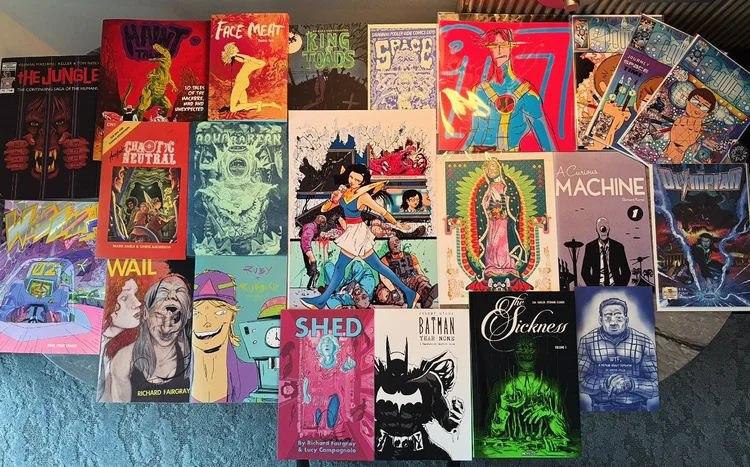
Overall, I just think of Heroes Con as the platonic ideal of a comics show. It’s chill and laid back, yet loaded with amazing art and cool artists. It feels like a buzzy show where you might discover a comic that will be absolutely huge next year (or the ashcan that will become that comic), but it’s entirely devoid of overly-corporate presences. There’s no movie stuff here, and very few celeb appearances (shout out to the Ecto-1). Hell, there aren’t even major publisher booths. Heroes Con makes you feel like you are in on a secret means of access to the best parts of the comics community, awash in fun new ideas that exist because the creators need them to exist, not because they’re part of some five-year blitz to have a mega-successful property or book. Two interactions this year really summed it up for me: one of the first tables I stopped at this year belonged to Thony Aiuppy, a comic artist from Jacksonville, who I believe was tabling for the second time ever. He was a nice guy, tabling for the weekend with his son, and he gave me this pitch: a risograph silent comic about a barabarian, where the barbarian is wearing an old-timey diving helmet, called The Aquabarbarian. I bought that as fast as I could, and you’ll see it among my haul (below).
|
|
That’s just good clean comics fun. Later in the weekend, I came across artist Jeremy Hyler’s table. I’d started following Jeremy on IG a while back, I believe at the recommendation of Comic Book Couples Counseling. Looking at the work on his table, I was immediately impressed. And then even more so when he should me a print of a forthcoming book he has (the print in the center of the image above), where the concept is Sailor Moon meets Darth Vader. If that’s not a big hit in the next few years, I don’t know comics. And the duology of those interactions really, to me, sums up why Heroes Con is the perfect comics show, one brimming with fun comics and cool people and a great mix of all the things there is to love about this industry/community/hobby.
|
Thing 3: The American Library Association Conference 2025Now for something completely different, the weekend after Heroes Con, I attended the American Library Association Conference in Philadelphia. This is not a consumer-facing show, not really. The public can buy passes to it, but it’s prohibitively expensive (imo). ALA is much more of a trade show, where the nation’s librarians gather to discuss their profession, national trends, and, perhaps most importantly, get to see books that publishers are pushing. There’s booth upon booth stacked high with all kinds of books at ALA, and often times publishers will let you just up and take them, so that you can later order them for your library in bulk and get them to readers near your home. ALA, to me, has a bit of a YA-skew to it. Although that doesn’t feel entirely right, either. I will just say that literary fiction isn’t really strongly represented there (you’d be better off going to AWP for that). And it’s a bit light on the deep genre stuff, since horror and sci-fi/fantasy tend to have their own shows for that (usually on the West Coast). So ALA has a broader flavor to it, but it’s still a great place to find books and to hear what librarians are looking for. I first went to this event in 2019 in Washington, D.C., and have been back to it twice.
|
|
And it’s started to feel to me like one of the most important days on the comics calendar. At a typical comics show, the majority of people are not readers. It sounds bad to say it that way, but that’s just how it is. Many people are there so their kids can see fun costumes. Others are there to wear those costumes. And still more are there for a $400+ photo with whoever is playing Batman right now. It’s not a reader-friendly environment. And of the folks who are comics readers at a show like SDCC or NYCC, the majority of them are not looking to find new comics to read. They’re there for con exclusive covers, or to hear whoever is writing Batman right now give a corporate PR-approved spiel about writing Batman. The difference is that at ALA, nearly everyone is trying to discover new books they didn’t know about when they got there. And with comics as a medium booming in cultural relevance (powered in recent years by a mix of successful film adaptations as well as Dogman and Raina Telgemeir’s absurd sales), librarians want comics. They know their communities want comics, and they want to give them to them. It makes for a different type of show for publishers and creators alike. I’m writing about this in-depth right now for a new piece to appear on The Beat, so I don’t want to conceptually scoop myself, but I talked to a good mix of publishers and creators who said ALA is one of their favorite shows of the year. That something like SDCC is good for industry networking, but ALA is better for positioning oneself in the current market, both in terms of selling books (to a mass amount of people who buy them professionally) and in hearing about what large numbers of readers want. Which brings me to my next topic…
|
Thing 4: The State of Comic Conventions in 2025What’s the function of the comic book convention as we know it in 2025? And I think for me personally, it’s hyper-specific to individual shows. The idea that all comic events provide an equal experience has probably always been wrong, but when I first started getting serious about covering/making comics about six years ago, the value proposition didn’t feel as staggered by individual show. You could table at plenty of shows and expect nearly the same set of benefits and drawbacks. I’m not so sure that’s true in 2025. There’s been a clear comics market contraction since the pandemic-sparked boom, when folks had extra money and were stuck home reading. And I think that’s trickled into every area of the industry. You see less indie titles taking off. It’s harder to really have a hit on Kickstarter. And there’s just a bit less foot traffic for emerging creators tabling at shows (which is the experience I can speak most directly to, since that’s what I am). And the actual numbers may seem a bit trivial, but going from two dozen sales over a weekend to a dozen sales over a weekend is really demoralizing (let me tell you). The difference between three or four sales over the course of eight hours on the floor under municipal convention center lights, and eight or nine sales is absolutely massive. So, it’s a lot to think about before putting out the money, time, and, frankly, energy to get yourself to one of these shows. For me, it comes down to value. I’d be better served putting my money into making more comics with high production value right now, and only tabling at places I know there will be active readers. Although, tabling anywhere is a nice way to mingle with your peers. So that’s where I’m at with shows in 2025. Would love to hear your thoughts as a fan, creator, editor, etc., so shoot me an email reply here if you’re so inclined!
|
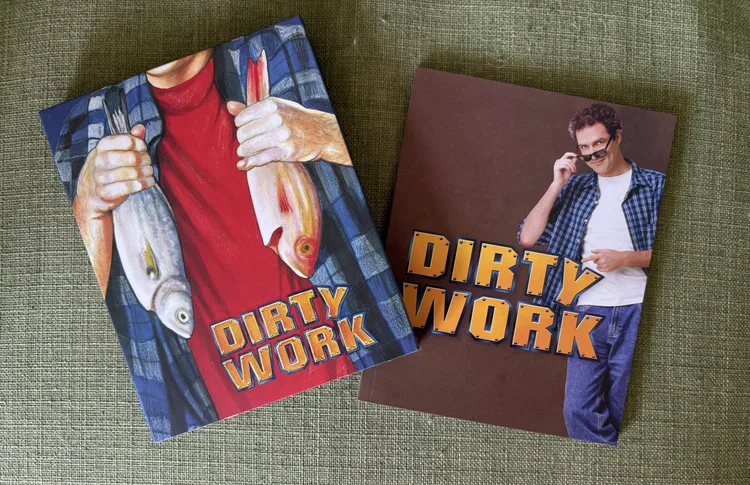
Thing 5: Dirtier WorkFinally, I want to brag about a recent physical media purchase I made — the newly-restored Dirty Work blu-ray from the fine folks at Vinegar Syndrome. Dirty Work is a 1998 studio comedy starring Norm MacDonald and Artie Lang, with direction by Bob Saget. It’s not a good movie in the traditional sense. The sets are cheap as all get out, and the performances are wooden. But what it is is an attempt to distill Norm MacDonald into a narrative movie with broad appeal. It’s interesting for that, and for all the fantastic jokes. There are cameo scenes here with Chevy Chase, Chris Farley, and Don Rickles that are among the funniest bits of ‘90s comedy. Period. This new blu-ray restoration has something colloquially known as the Dirtier Work cut. And it’s amazing. I had this film on VHS as a (too-young) kid, and my brothers and I practically memorized it. What the new cut delivers is small tweaks and additions that make the move even more Norm, if that makes sense, and were clearly taken out by the studio, who probably hoped this could be the next Billy Madison or something. Anyway, I bought the thing and I love it. It’s a nice trip down memory lane, a fascinating look at a comedic genius who made a good faith attempt to play within the system (something that feels super dated now), and a fun bit of ‘90s nostalgia. Vinegar Syndrome’s site was down in preparation for a sale as of this writing, but I imagine they may still have it for sale. Here it is if you’re interested.
|
|
Conclusion Phew. That’s a whole lot of thoughts and a bit rambly. Apologies, but as I noted, I’ve been travelling a lot lately and am very tired. Up next for me is a trip to San Diego Comic Con, specifically for the Eisner Awards, where The Beat (the site where I am the reviews editor) is nominated for Best Comics Journalism. That should be fun. I’m also waiting on colors back for the first inked story in Death of Comics Bookcase, Vol. 2, which is a collaboration between myself and John P. Golden (instagram). I’m not ready to say much about it yet, because we’re still many months away from that promotional cycle, but here’s a little tease for you for reading this far.
|
|
Cheers, be well, and please forgive any and all typos above! -Zack Q.
|
|
|
|